
Introduction
There was a time when launching a business meant writing a 50-page document, printing it, binding it, and hoping someone would read it. Today, that approach feels outdated—especially in Ethiopia’s rapidly evolving digital landscape.
With the rise of Digital Ethiopia 2025 and the broader 2030 vision, the barriers to entry for tech startups have dropped dramatically. Mobile penetration is rising, fintech platforms like Telebirr and CBE Birr are mainstream, and universities such as AAU and Haramaya are producing a new generation of tech-driven thinkers.
Today, the landscape has shifted. The Digital Ethiopia 2025/2030 Strategy has fundamentally lowered the barrier to entry. With the expansion of Safaricom and Ethio Telecom, and the explosion of digital payment gateways, the “infrastructure excuse” is evaporating. But a new challenge has emerged: how do you build fast enough to survive in a market that is leapfrogging decades of development in just a few years?
But here’s the reality: speed matters more than perfection.
This is where the Lean Canvas becomes a game changer. Instead of spending months planning, founders can map, test, and refine their ideas in days. For Ethiopian entrepreneurs navigating a fast-changing market, this isn’t just helpful—it’s essential.
The Past vs. Present: From Heavy Plans to Smart Experiments
Traditional business thinking in Ethiopia—and globally—was built on predictability. You researched, wrote, projected, and then executed.
That model struggles in today’s environment.
Old Approach (Analogue Thinking)
- Long, static business plans
- Assumptions treated as facts
- Delayed market entry
- High upfront investment
- Minimal customer feedback early on
New Approach (Lean Methodology)
- One-page business model (Lean Canvas)
- Assumptions tested quickly
- Launch fast, iterate faster
- Build only what users need
- Continuous feedback loop
For example, a startup in Addis Ababa building a delivery app no longer needs to fully develop the platform before testing. A simple WhatsApp-based MVP (Minimum Viable Product) can validate demand within days.
The shift is clear: learning beats planning.
The 9 Lean Canvas Blocks in an Ethiopian Context
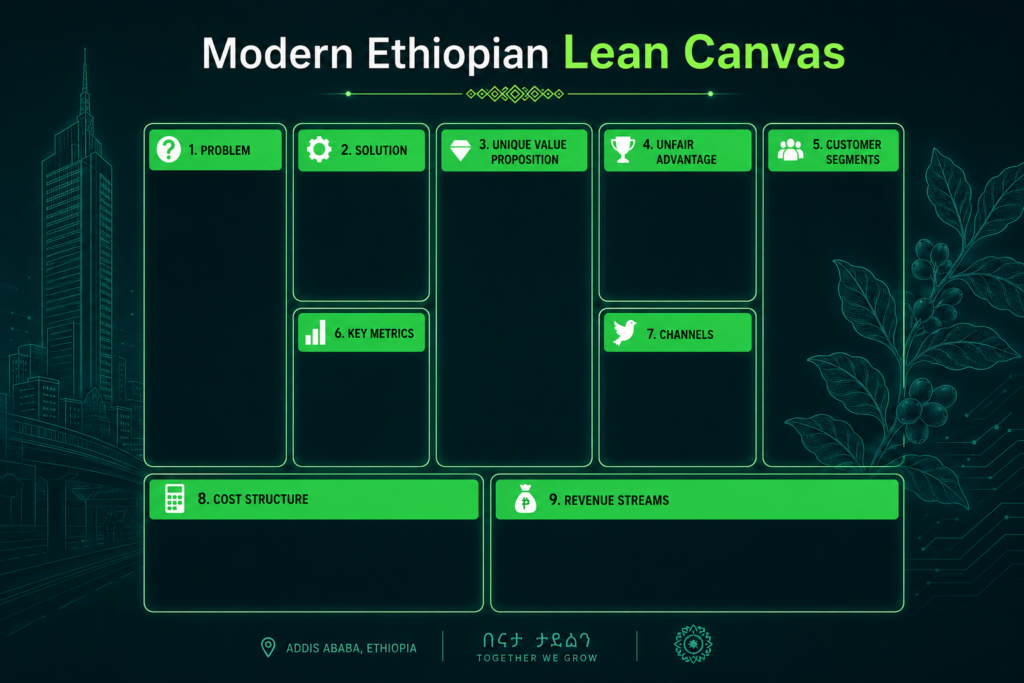
Let’s break down each block of the Lean Canvas with practical, local examples relevant to Ethiopia’s tech ecosystem.
1. Problem
Start with the “pain.” Don’t list features; list frustrations. In Ethiopia, these are often related to trust, language, or logistics. Start with real pain points—not assumptions.
Ask:
- What frustrates people daily?
- What inefficiencies exist in local systems?
Ethiopian Example:
- Small businesses face difficulty tracking digital payments
2. Customer Segments
Define who experiences the problem.
Examples:
- Urban youth in Addis using smartphones
- Rural farmers with limited internet access
- University students at AAU or Haramaya
- SMEs adopting digital payments
Avoid “everyone” as a target. Specificity wins.
3. Unique Value Proposition (UVP)
What makes you different? Why should a customer choose you over a traditional method or a competitor? This is your promise—why your solution matters.
It should answer:
- Why should users care?
- What makes you different?
Example:
- “Real-time crop pricing via SMS for Ethiopian farmers”
Keep it clear, bold, and relevant.
4. Solution
What are the top three features that solve the problems you listed? Keep it minimal. If you’re building a delivery app, focus on the delivery, not the fancy animations.
List your top features—not everything.
Example (Afaan Oromo AI Hub concept):
- Speech-to-text in Afaan Oromo
- Learning chatbot for students
Example (Fintech app):
- Telebirr integration
- Instant payment tracking
- Expense dashboard
Build only what solves the core problem.
5. Channels
How will you reach your customers? In our market, digital ads are rarely enough
How do you reach users?
In Ethiopia, digital and offline channels both matter.
Effective Channels:
- Telegram groups (very popular locally)
- University tech hubs
- Facebook pages and ads
- Community events and startup hubs
- Partnerships with local cooperatives
Don’t ignore grassroots distribution—it’s powerful.
6. Revenue Streams
How will you make money?
Integration is Key: Your Lean Canvas must account for the reality of Telebirr and CBE Birr. If your revenue model depends on international credit cards, your canvas is broken for the local market.
Common Ethiopian Models:
- Subscription (monthly app access)
- Transaction fees (e.g., payment services)
- Freemium (basic free, premium features paid)
- B2B licensing (selling to institutions)
Example:
- A fintech app charging a small fee per Telebirr transaction
- An AI learning platform offering premium courses
7. Cost Structure
What are your “burn” items? Consider the high cost of specialized tech talent and the price of reliable server hosting in a region where connectivity can be inconsistent.
What are your biggest expenses?
Typical Costs:
- Development (developers, tools)
- Cloud hosting
- Marketing and user acquisition
- Operations and support
Keep costs lean early. Avoid overbuilding.
8. Key Metrics
Forget “vanity metrics” like Facebook likes. What number actually proves your business is alive?
Example: Instead of “Total Downloads,” track “Repeat Transactions” or “Daily Active Users who complete a task.”How do you measure success?
Focus on actionable metrics.
Examples:
- Daily active users
- Number of transactions
- Customer retention rate
- Cost per acquisition
For instance, if you’re building a delivery app, track:
- Orders per day
- Delivery time
- Repeat customers
Metrics should guide decisions—not just reports.
9. Unfair Advantage
This is the hardest block. What do you have that a competitor with $1 million can’t buy? What makes you hard to copy?
This is often the toughest part.
Examples:
- Deep local knowledge of Ethiopian markets
- Strong partnerships (e.g., with universities or telecoms)
- Proprietary datasets (e.g., Afaan Oromo language data)
- First-mover advantage in underserved niches
For example, a startup building an Afaan Oromo AI Hub with unique language data has a strong edge.
Validation & The Ethiopian Startup Act
The most dangerous thing a founder can do is be “right” too early. Startup Validation is the process of getting out of the office and talking to the people who will actually pay you.
The upcoming Ethiopian Startup Act is designed to provide the legal framework for this experimentation—offering tax incentives and support for those willing to innovate. However, the law can’t save a bad business model. This is where the Pivot comes in.
If your Lean Canvas shows that your “Solution” isn’t solving the “Problem,” you don’t quit. You change a block. Maybe your “Customer Segment” was wrong. Maybe your “Channel” should be offline instead of online. We treat our canvas as a living breathing document, not a static stone tablet.
A great idea means nothing without validation.
This is where many founders struggle—they build first, test later. That’s backwards.
What is Startup Validation?
It means:
- Testing assumptions with real users
- Gathering feedback early
- Adjusting your idea based on data
Simple Validation Methods:
- Talk to 10–20 potential users
- Launch a basic prototype
- Use surveys or WhatsApp groups
- Track user behavior
The Role of the Ethiopian Startup Act
The Ethiopian Startup Act is designed to:
- Support innovation
- Provide incentives for startups
- Create a structured ecosystem
But policy alone isn’t enough.
Founders must:
- Move fast
- Experiment constantly
- Be willing to pivot
Pivoting: The Smart Founder’s Move
Pivoting is not failure—it’s strategy.
Example:
A startup begins as a delivery app but realizes users care more about payment tracking. It pivots into a fintech tool integrated with CBE Birr.
That’s Lean thinking in action.
Looking Ahead: Building for Ethiopia 2030
The 2030 Horizon: Your Role in the Digital Republic. As we march toward Digital Ethiopia 2030, the goal is clear: a tech-driven economy that creates jobs and solves local problems. The startups that will lead this charge aren’t necessarily the ones with the most funding; they are the ones that are the most “Lean.” They are the ones that understand their customers better than anyone else because they weren’t afraid to test, fail, and adapt.
By mastering the Lean Canvas today, you aren’t just planning a business; you are building the foundation for a digital legacy that will serve the next generation of Ethiopians.
Ethiopia’s digital future is not theoretical—it’s unfolding now.
By 2030, we’ll likely see:
- Stronger fintech ecosystems
- AI solutions in local languages
- Digitized agriculture and logistics
- Growth of startups like MiraTech pushing innovation
The opportunity is massive—but only for those who move smart and fast.
Final Thought & Call to Action
The Lean Canvas is not just a tool—it’s a mindset.
It forces you to:
- Focus on real problems
- Test quickly
- Adapt continuously
If you’re serious about building in the Ethiopian tech ecosystem, start here.
👉 Take 10 minutes today and write down:
- Your top 3 problems
- Your target users
- Your simple solution
Then share your Problem Statement—with peers, mentors, or even here—and get feedback.
That’s how real startups begin.