
By Meyra Blogs Team | Category: Future Technology · Career Guide · Intermediate Published: June 2026 · Reading Time: ~14 minutes
“The most dangerous career position in 2026 is not being replaced by AI — it’s being replaced by someone who uses AI better than you do. There’s a meaningful difference, and only one of them is in your control.”
Introduction: The Skills Gap Is No Longer a Future Problem
Let’s say something most career blogs won’t: if you are not actively learning AI skills right now, you are falling behind. Not in five years. Right now. And the gap between people who act on this and people who wait is widening every single month.
In 2026, AI is no longer a niche technology for Silicon Valley engineers. It’s embedded in healthcare, finance, education, marketing, law, agriculture, design, journalism, and almost every other field you can name. The question is no longer “will AI affect my industry?” — it already has. The real question is: are you equipped to work with it — or are you being replaced by someone who is?
This guide is for professionals who feel that urgency. For students who want to graduate future-ready. For career changers looking for skills with the highest ROI. And for anyone who has typed “AI skills to learn” into a search bar and gotten overwhelmed by vague, outdated advice.
We’re going to fix that. This is specific, honest, and built for 2026.
Why 2026 Is the Year the Skills Gap Became a Crisis
For the past few years, AI skills were a competitive advantage — a way to stand out in a job application or accelerate a project. That phase is over.
In 2026, AI skills are table stakes. They are no longer what makes you impressive. They are what makes you employable.
Three things happened to create this inflection point:
1. AI tools became genuinely useful. Early AI was a curiosity. You could ask it questions and get unreliable answers. The generation of tools available in 2026 — GPT-4o, Claude 3.5, Gemini Ultra, Midjourney V6 — are genuinely capable of replacing significant portions of knowledge work. The technology crossed a quality threshold that changed everything.
2. Adoption accelerated past the tipping point. According to McKinsey’s 2026 AI Adoption Report, over 65% of enterprise companies now have at least one AI tool deployed across core operations — up from 28% in 2023. When a majority of companies are using AI, the workers inside those companies who can’t use it become a liability.
3. The premium for AI skills exploded. LinkedIn’s 2026 Workforce Insights report shows that job postings explicitly listing AI skills now offer an average of $28,000 more per year than equivalent non-AI roles. In some sectors — finance, healthcare, and technology — that premium exceeds $50,000.
This is not a drill. The skills gap is real, it’s accelerating, and the workers who close it in the next 12 months will be writing the next decade of their career from a position of strength.
Key Numbers You Need to Know
| Statistic | Figure |
|---|---|
| Jobs displaced globally by AI by 2027 (WEF) | 85 million |
| New AI-adjacent roles expected by 2027 | 97 million |
| Employers now screening for AI literacy | 69% |
| Average salary premium for AI-skilled workers | +$28,000/year |
Mindset shift: Stop asking “will AI take my job?” Start asking “how do I become the person who uses AI so effectively that I make three other people’s jobs unnecessary?” The first question leads to anxiety. The second leads to a plan.
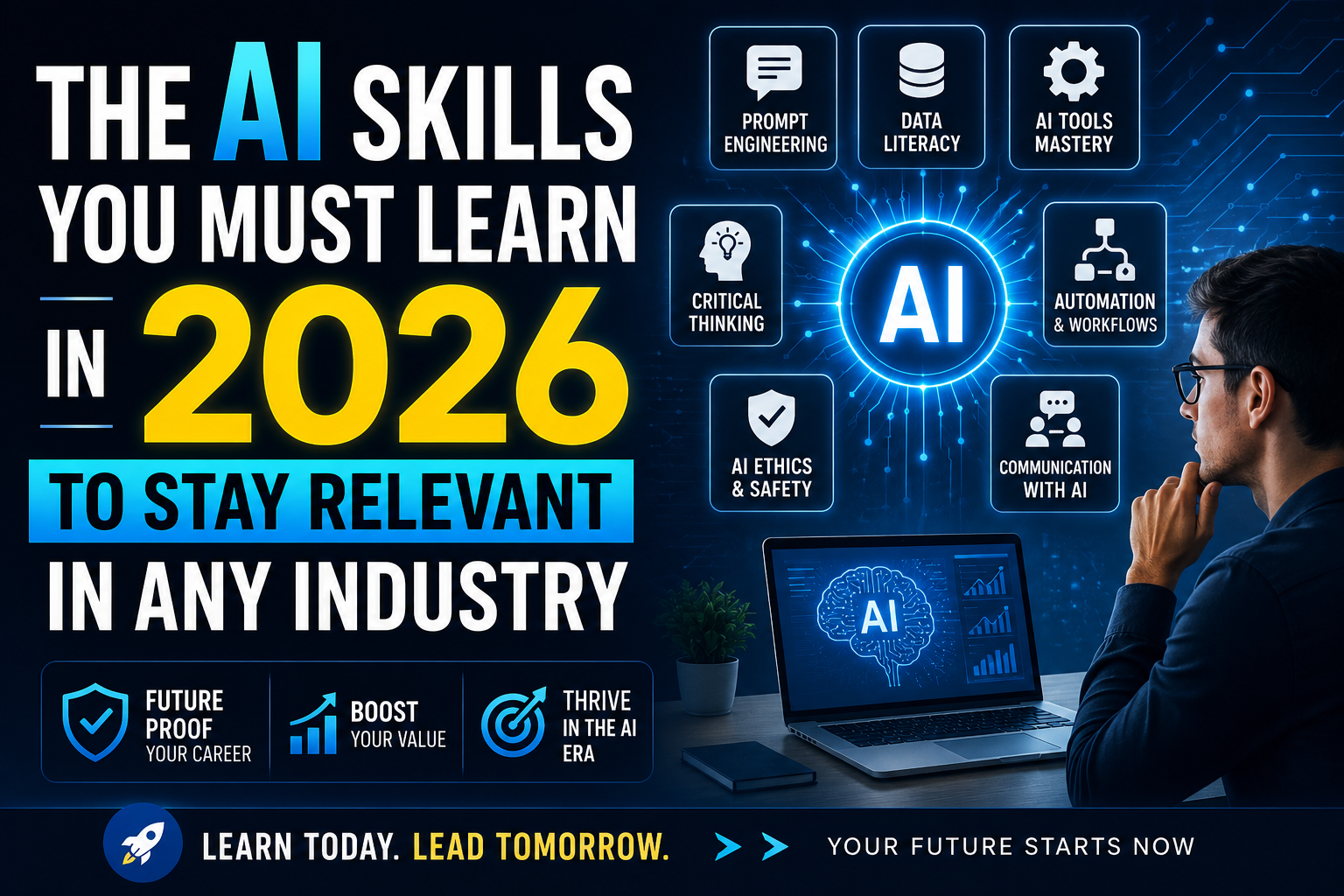
The 8 AI Skills You Must Build in 2026
These are ordered by urgency and universal applicability — starting with skills every professional in every industry needs, moving toward more specialized capabilities with very high earning potential.
Skill 1: Prompt Engineering
Priority: 🔴 Essential — All Industries
The ability to communicate with AI tools effectively to get high-quality, useful output. This is the foundational skill that multiplies the value of every other AI tool you use. Poor prompts produce mediocre results. Excellent prompts produce results that replace hours of manual work.
Most people who use ChatGPT or Claude are leaving 80% of the value on the table simply because they don’t know how to prompt properly. This is entirely fixable — in about two weeks of deliberate practice.
The RCTF Prompt Framework — four elements that separate average users from power users:
- R — Role: Tell the AI who it is. “You are a senior financial analyst with 15 years of experience…”
- C — Context: Give the specific situation. “I am preparing a report for a board meeting about Q2 revenue decline…”
- T — Task: State exactly what you need. “Write a 300-word executive summary that identifies the top 3 causes…”
- F — Format: Specify the output format. “Use bullet points, plain language, no jargon, and end with a single recommendation.”
Weak prompt: “Write me a marketing email about our new product.”
Strong RCTF prompt: “You are a senior email marketing copywriter specializing in SaaS products. I’m launching a project management tool for remote teams of 5–20 people. The key differentiator is our AI meeting summarizer. Write a 200-word launch email to existing free-plan customers. Tone: conversational and urgent. End with a CTA to upgrade. Provide 3 subject line options.”
The second prompt produces output you can use immediately. The first produces generic content you’ll spend 30 minutes rewriting. That difference is entirely skill — and it’s learnable.
Best resource: PromptingGuide.ai · Time to learn: 1–2 weeks
Skill 2: AI Tool Fluency
Priority: 🔴 Essential — All Industries
Knowing which AI tool solves which problem — and having real, deep proficiency with the tools in your specific field. A marketer who genuinely knows ChatGPT, Canva AI, and HubSpot AI is more valuable than one who has dabbled in 20 tools and mastered none.
The mistake most people make is trying to use every new tool that launches. Resist this. Build genuine proficiency with 3–5 tools that directly serve your work, and treat everything else as background awareness.
Best resource: YouTube tutorials + 30 days of daily use · Time to learn: 2–4 weeks
Skill 3: Data Literacy
Priority: 🔴 Essential — All Industries
The ability to read, interpret, and act on data — even without being a data scientist. AI generates enormous amounts of insights and analytics. Professionals who can understand what that data means and translate it into decisions will be indispensable in any organization.
Data literacy in 2026 does not mean knowing how to build machine learning models. It means being able to look at a dashboard and ask the right questions. Being able to distinguish a correlation from a cause. Being able to tell a story with numbers in a meeting.
Best resource: Google Data Analytics Certificate (Coursera, free) · Time to learn: 4–8 weeks
Skill 4: AI Workflow Automation
Priority: 🟢 High Priority — Business & Operations
Building automated systems using tools like Zapier, Make (formerly Integromat), and n8n to connect AI tools and eliminate repetitive manual work. Professionals who can design and implement automation workflows are saving their organizations thousands of hours annually.
You don’t need to write code. Modern no-code automation tools allow you to connect apps, trigger actions, and embed AI steps (like ChatGPT summaries or email drafts) into workflows with drag-and-drop interfaces.
Best resource: Zapier Learn + Make Academy · Time to learn: 3–6 weeks
Skill 5: Critical Evaluation of AI Output
Priority: 🔴 Essential — All Industries
The ability to assess, verify, and improve AI-generated content and decisions. As AI handles more output generation, the premium human skill becomes knowing when AI is wrong — and fixing it. This is the quality control layer that separates amateurs from professionals.
AI tools hallucinate facts, miss nuance, produce biased content, and generate confident-sounding nonsense. Professionals who can reliably identify these failures — and correct them — become indispensable in any AI-augmented workflow.
Best resource: Daily practice with real AI outputs + fact-checking habit building · Time to learn: Ongoing
Skill 6: AI Agent Development
Priority: 🟢 High Priority — Tech & Business
Understanding how to build and deploy AI agents — autonomous systems that can research, plan, execute multi-step tasks, and use tools without continuous human input. No-code agent builders like Relevance AI and AgentGPT have made this accessible to non-developers.
In 2026, AI agents are handling customer support queues, doing competitive research, managing social media scheduling, processing job applications, and executing marketing campaigns — all autonomously. The professionals who can build and manage these agents are in extremely high demand.
Best resource: Relevance AI documentation + LangChain beginner courses · Time to learn: 4–8 weeks
Skill 7: AI Ethics and Responsible Use
Priority: 🟡 Growing — Governance & Compliance
Understanding bias, privacy, intellectual property, and ethical implications of AI use in professional contexts. Organizations are increasingly requiring employees to apply AI responsibly. Those with genuine literacy in AI ethics are rapidly becoming essential in legal, HR, healthcare, and government roles.
This is not a soft skill. It is becoming a hard regulatory requirement in the EU, and is increasingly referenced in corporate AI policies globally. Professionals who can navigate these issues will be sought after as AI governance roles multiply.
Best resource: Oxford AI Ethics online course · Time to learn: 4–6 weeks
Skill 8: Python for AI and Automation
Priority: 🟡 Growing — Technical Roles
Basic Python programming specifically applied to AI tools, data processing, and automation. You don’t need to become a software engineer. But professionals who can write simple Python scripts to interact with AI APIs, process datasets, and build custom tools are earning significant salary premiums in 2026.
Even learning enough Python to automate a spreadsheet task, pull data from an API, or run a simple AI workflow puts you in a dramatically stronger position than the average professional in almost any field.
Best resource: fast.ai + Python.org official tutorial · Time to learn: 8–16 weeks
AI Skills Priority Table
| Skill | Urgency | Earning Premium | Time to Learn | Best Free Resource |
|---|---|---|---|---|
| Prompt Engineering | 🔴 Critical | +15–30% | 1–2 weeks | PromptingGuide.ai |
| AI Tool Fluency | 🔴 Critical | +20–40% | 2–4 weeks | YouTube + daily practice |
| Data Literacy | 🔴 Critical | +25–50% | 4–8 weeks | Google Data Analytics (Coursera) |
| AI Workflow Automation | 🟠 High | +30–60% | 3–6 weeks | Zapier Learn + Make Academy |
| Critical AI Evaluation | 🟠 High | +20–35% | Ongoing | Daily AI practice |
| AI Agent Development | 🟠 High | +40–80% | 4–8 weeks | Relevance AI docs |
| AI Ethics & Governance | 🟡 Growing | +30–55% | 4–6 weeks | Oxford AI Ethics online |
| Python for AI | 🟡 Growing | +50–100% | 8–16 weeks | fast.ai |
AI Skills by Industry: What Your Specific Field Needs
Broad AI literacy matters universally. But each industry also has specific AI tools and applications that are becoming standard. Here’s where to focus based on your field.
🏥 Healthcare
AI diagnostics tools, clinical NLP, patient data privacy, AI-assisted documentation, telehealth platforms
💰 Finance & Banking
Predictive analytics, fraud detection AI, NLP for regulatory documents, automated reporting, AI trading fundamentals
📣 Marketing
Generative content tools, AI ad targeting, personalization engines, analytics interpretation, SEO AI tools
⚖️ Legal
AI contract review, legal research automation, document summarization, AI ethics and compliance, Harvey AI
🎓 Education
Personalized learning AI, AI content creation, assessment automation, AI tutoring tools, curriculum design with AI
🏗️ Engineering
AI-assisted CAD design, predictive maintenance, GitHub Copilot, simulation AI, supply chain optimization
🎨 Creative Industries
Midjourney, Sora, ElevenLabs, Adobe Firefly, AI-assisted writing, brand AI tools, creative direction of AI
🌾 Agriculture
Precision farming AI, drone data analysis, crop prediction models, climate AI tools, supply chain AI
Special Note for African Professionals: Africa’s fastest-growing sectors — agriculture, fintech, healthcare, and education — are seeing accelerated AI adoption in 2026. Professionals in Ethiopia, Kenya, Nigeria, and Ghana who develop AI skills now are positioning themselves at the front of an enormous regional wave of AI-driven economic development.
Your 90-Day AI Skills Learning Roadmap
Knowing what to learn is only half the equation. Here is a practical, structured timeline to go from AI beginner to genuinely AI-skilled professional in 90 days — without quitting your job or spending a fortune.
Days 1–14: Foundation — Master One AI Tool Completely
Choose ChatGPT or Claude. Use it every single day on real work tasks. Study prompt engineering using PromptingGuide.ai. Complete at least 50 different prompting tasks across writing, research, analysis, and problem-solving.
The goal is not to dabble — it’s to build genuine proficiency with one tool before touching another.
Focus tools: ChatGPT or Claude · Prompt Engineering · Daily practice
Days 15–30: Industry Stack — Build Your Field-Specific AI Toolkit
Research the top 3–5 AI tools in your specific industry. Sign up for free trials. Run actual tasks from your current job through each tool and evaluate the results honestly. Pick 2–3 that genuinely improve your output and commit to learning them deeply. Cancel the rest.
Focus tools: Industry-specific AI tools · Real workflow testing · Stack building
Days 31–50: Data Literacy — Learn to Read and Act on Data
Enroll in Google’s free Data Analytics certificate on Coursera or complete LinkedIn Learning’s Data Literacy path. Focus specifically on understanding dashboards, interpreting charts, and making decisions from data outputs.
You don’t need to build models — you need to understand what they produce and ask the right questions.
Focus tools: Google Analytics · Data interpretation · Decision-making from dashboards
Days 51–70: Automation — Automate One Real Workflow
Pick one repetitive task in your current work or business and build an automation for it using Zapier or Make.com. Connect at least two apps, incorporate an AI step (like a ChatGPT summary), and document what you built.
This hands-on project is worth more than any certificate — it’s proof you can build real systems, not just talk about them.
Focus tools: Zapier or Make · No-code automation · Portfolio project
Days 71–90: Credibility — Document and Showcase Your Skills
Update your LinkedIn profile with specific AI tools and use cases. Write a LinkedIn post or short article describing one AI project you built. Pursue 1–2 recognized certifications.
Credibility compounds: start building it before you need it.
Focus tools: LinkedIn profile · AI certifications · Portfolio writing
The Best Free Resources to Learn AI Skills in 2026
You do not need to spend thousands of dollars on AI education. The best learning resources in 2026 are either free or close to it.
Free Certifications Worth Adding to Your LinkedIn
- Google AI Essentials — Google’s foundational AI certificate. Practical, respected, and free via Coursera. Ideal for all industries.
- Microsoft AI-900 (Azure AI Fundamentals) — Industry-recognized. Free learning paths on Microsoft Learn. Particularly valuable for corporate and enterprise roles.
- IBM AI Foundations for Everyone — IBM’s beginner-friendly AI certificate via Coursera. Excellent for non-technical professionals.
- HubSpot AI Marketing Certificate — Specifically for marketers. Free, quick, and immediately applicable.
- DeepLearning.AI Short Courses — Andrew Ng’s platform offers free, high-quality short courses on prompt engineering, LangChain, and building with AI APIs. Highly recommended.
Communities That Accelerate Learning
- Reddit r/artificial and r/ChatGPT — For news, tool discoveries, and real user experiences
- LinkedIn AI communities — For professional connections and industry-specific AI discussions
- Discord servers for specific tools — Midjourney, ElevenLabs, and most major AI tools have active communities with tutorials and early access
- Twitter/X AI space — Following AI researchers here gives real-time awareness of developments weeks before mainstream media
- Local AI meetups — In Addis Ababa, Nairobi, Lagos, and other African cities, AI professional communities are forming rapidly. Find them on Meetup.com and LinkedIn Events.
What You Should Actually Be Afraid Of (And What You Shouldn’t)
The Real Threat: Skills Stagnation
The professionals most at risk from AI disruption are not those whose jobs involve complex thinking, creativity, emotional intelligence, or human judgment. They are those who have stopped learning entirely — relying on skills that haven’t evolved in 5–10 years and assuming their experience alone will protect them.
AI is not the threat. Stagnation is.
The Jobs AI Cannot Touch (Yet)
The safest professional positions share common traits:
- High human judgment — Roles requiring reading a room, building trust, or making ethical calls in complex, ambiguous situations (senior leadership, counseling, negotiation)
- Deep physical presence — Skilled trades, hands-on healthcare, construction, and manufacturing
- Genuine creativity and originality — True creative vision, cultural insight, and original artistic expression (not just content generation)
- AI oversight and governance — Ironically, one of the fastest-growing role categories is people who manage, audit, and control AI systems
Honest warning: If your current role primarily involves generating content, processing data, conducting basic research, creating standard designs, or doing repetitive analysis — and you are not actively learning to use AI tools — your role is materially at risk within 24–36 months. This is what the job posting data, automation research, and productivity studies consistently show.
Conclusion: The Window Is Open — But Not Forever
The people who are going to win the next decade of their careers are not necessarily the most talented, most experienced, or most credentialed. They are the ones who recognized this moment for what it is — a rare window where early adoption of the right skills creates compounding, lasting advantage — and acted on it.
You are reading this article, which means you’re already more aware than most. Awareness is the first step. But awareness without action is just anxiety with better information.
The 90-day roadmap in this article is achievable. The resources are free or nearly free. The skills are learnable regardless of your background, industry, or current technical level.
The future does not belong to AI. It belongs to the people who learn to work with it.
Start today. Not next week. Today.
Key Takeaways
- The AI skills gap is no longer a future problem — it’s a present crisis affecting hiring and salaries in 2026
- Prompt engineering is the single most universal AI skill and can be learned in 1–2 weeks
- Every industry has specific AI tools becoming standard — identify and master yours before competitors do
- Data literacy, AI workflow automation, and AI agent development offer the highest earning premiums
- The 90-day roadmap in this article takes you from beginner to credentialed AI practitioner using free resources
- African professionals have a unique opportunity as regional AI adoption accelerates — first movers will have structural advantages
- The real threat is not AI replacing you — it’s being outcompeted by someone who uses AI better than you
Frequently Asked Questions
Q: How long does it really take to become AI-skilled? The foundational skills — prompt engineering and tool fluency — can be developed in 2–4 weeks of daily practice. A functional, credentialed AI skill set takes 90 days of deliberate effort. The first 30 days produce the majority of the career benefit.
Q: Do I need a technical background to learn AI skills? No. For the most valuable and universally applicable AI skills in 2026, you don’t need any coding background. Prompt engineering, AI tool fluency, data literacy, and workflow automation are all accessible to non-technical professionals. Python for AI is the only technical skill on this list.
Q: Which AI certification is most valuable for getting a job in 2026? For general credibility: Google AI Essentials and Microsoft AI-900. For technical roles: DeepLearning.AI certificates. For marketing: HubSpot AI Marketing Certificate. That said, a practical portfolio project demonstrating real AI skill will always outweigh a certificate in an interview.
Q: What if my employer doesn’t use AI tools yet? Build the skills anyway. Your employer will adopt AI tools within 12–24 months. Being the person in your organization who already understands AI when that moment comes is an enormous career opportunity. AI skills are also portable — they make you more competitive in your next job search.
Q: Is it too late to start learning AI skills in 2026? No — but the window for early-mover advantage is closing. In 2024, learning AI skills made you stand out. By 2028, they will be baseline requirements. Right now in 2026, building these skills still puts you ahead of the majority of the global workforce.
Found this guide useful? Save it, share it with someone who needs it, and subscribe to Meyra Blogs for weekly deep-dives on AI tools, future technology, and digital income strategies for Africa and the world.
— Meyra Blogs Team | miratech.com.et
Tags: AI Skills to Learn 2026, AI Career Skills, Future Proof Career AI, Prompt Engineering, Data Literacy, AI Workflow Automation, AI Tools for Professionals, AI Certifications, Remote Work Skills, Career Development Ethiopia