


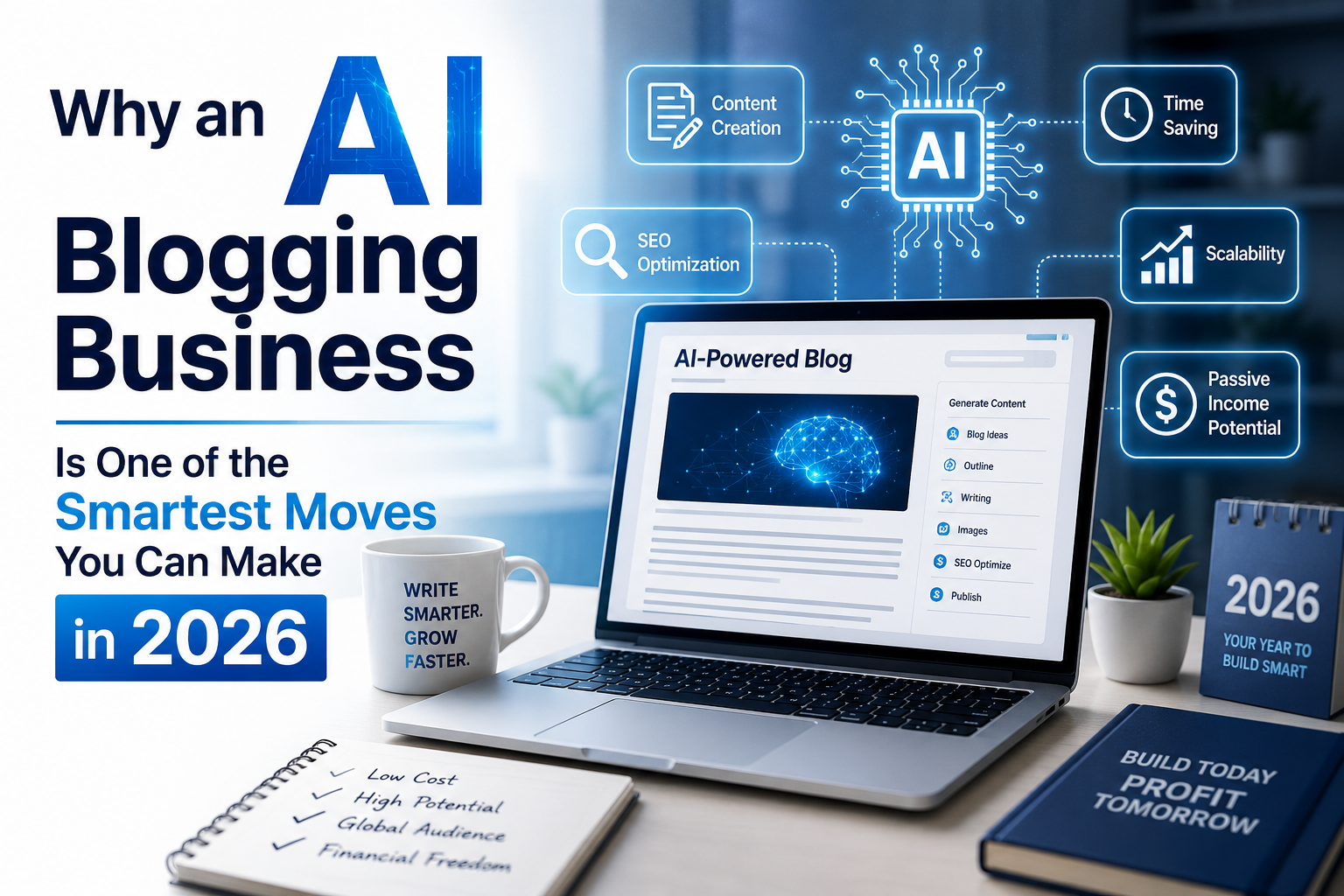
Why an AI Blogging Business Is One of the Smartest Moves You Can Make in 2026
Blogging has existed for over two decades, and consequently many people assume it is too late, too saturated, or too slow to be worth starting in 2026. This assumption is wrong — and AI is the exact reason why.
Furthermore, AI has fundamentally changed the economics of blogging. What once required 6–8 hours of research and writing per article now takes 60–90 minutes with the right AI workflow. As a result, a single dedicated person can now build and maintain a content library that would have previously required a small team — making blogging dramatically more accessible to solo entrepreneurs than at any point in its history.
This guide is a complete, step-by-step roadmap for building a genuinely profitable AI blogging business in 2026 — not a vague overview, but the exact sequence of decisions, tools, and actions required to go from zero to a revenue-generating blog. In addition to the roadmap itself, we cover realistic timelines, specific AI tools for every stage, and the monetization strategies that actually work in today’s market.
Let’s build your AI blogging business, step by step.
What Makes an AI Blogging Business Different in 2026
Before the roadmap, it’s worth clarifying what “AI blogging business” actually means — because the term gets misused frequently.
An AI blogging business is NOT:
- A website that publishes unedited, low-quality AI-generated content at scale
- A “set it and forget it” passive system requiring zero ongoing effort
- A get-rich-quick scheme that ignores SEO fundamentals and reader value
An AI blogging business IS:
- A content business where AI tools accelerate research, drafting, and production
- A system where human judgment, editing, and strategy remain central to quality
- A business built on genuine reader value that happens to be produced more efficiently using AI
Consequently, the bloggers succeeding with AI in 2026 are not the ones publishing the most content with the least effort. They are the ones using AI to publish significantly more high-quality content than they could have produced manually — while maintaining the editorial standards that keep readers coming back and Google ranking their pages.
Phase 1: Foundation (Weeks 1–2)
Step 1: Choose Your Niche Using Data, Not Passion Alone
Furthermore, niche selection is the single most important decision in this entire roadmap. Most blogging failures trace back to a poorly chosen niche, regardless of how much effort went into content production afterward.
The criteria for a profitable niche in 2026:
- Monetization potential — Does this niche have products, services, or affiliate programs that pay meaningful commissions?
- Search demand — Are people actively searching for information in this space? Use Google Trends and Ubersuggest (free tier) to verify
- Competition level — Can a new blog realistically rank, or is the space dominated entirely by massive established publishers?
- Your genuine interest or expertise — Can you sustain writing about this topic for 12+ months without burning out?
High-potential niches for 2026 AI blogging businesses:
- AI tools and technology reviews (the niche this very guide exists within)
- Personal finance and investing for specific demographics
- Online business and make-money-online strategies
- Health and wellness for specific conditions or lifestyles
- Remote work and productivity tools
- Regional and local business guides (e.g., business guides specific to Ethiopia or East Africa)
Pro Tip: Use ChatGPT to analyze your shortlist of niche ideas. Ask it: “Analyze these 5 potential blog niches for monetization potential, competition level, and growth trends in 2026: [list your niches].” Consequently, you get a structured comparison in minutes rather than days of manual research.
Step 2: Validate Your Niche With Real Keyword Research
In addition to choosing a niche conceptually, you must validate it with actual search data before investing months of effort.
Free tools for keyword validation:
- Google Keyword Planner (free with a Google Ads account, no spending required)
- Ubersuggest (free tier — limited searches per day)
- AnswerThePublic (free tier — shows actual questions people ask)
- Google Trends (completely free — shows search interest over time)
What to look for: Find 20–30 keywords with reasonable search volume (500–5,000 monthly searches) and manageable competition. Furthermore, prioritize long-tail keywords (3–5 word phrases) over single broad terms, since they are dramatically easier to rank for as a new blog.
Step 3: Set Up Your Blogging Platform
Consequently, your technical setup should be simple and fast — this is not where you should spend weeks of effort.
Recommended setup:
- Domain name — Choose a brandable, memorable name through Namecheap or GoDaddy ($10–15/year)
- Hosting — Use affordable, reliable hosting like Hostinger or Bluehost ($3–8/month for beginners)
- WordPress — The platform of choice for 95% of successful blogging businesses, due to its flexibility and SEO-friendly structure
- Yoast SEO plugin — Essential for on-page optimization from your very first post
- A clean, fast theme — Avoid heavy, bloated themes; speed directly affects both SEO and reader experience
Total setup cost: $50 – $150 for the first year — one of the lowest barriers to entry of any online business model.
Phase 2: Building Your AI Content Production System (Weeks 3–4)
Step 4: Build Your AI Writing Workflow
Furthermore, this is where AI transforms blogging from a slow, manual process into a scalable production system. Here is the exact workflow used by successful AI bloggers in 2026.
The 6-Step AI Content Production Workflow:
- Topic and keyword selection — Choose your target keyword from your validated list
- Research with Perplexity AI — Gather current facts, statistics, and source material on the topic
- Outline generation with ChatGPT or Claude — Generate a structured outline based on what’s currently ranking for your keyword
- Draft generation — Use Claude for long-form, nuanced content or ChatGPT for faster, more direct drafts
- Human editing pass — Add your unique insights, personal examples, and voice; verify all facts independently
- SEO optimization with Yoast — Optimize the final draft against your target keyword before publishing
Consequently, this workflow typically takes 60–90 minutes per 1,200–1,500 word article once you have practiced it — compared to 4–6 hours for fully manual writing.
Step 5: Establish Your Content Calendar
In addition to the writing workflow itself, consistency is what separates successful blogs from abandoned ones. Furthermore, Google’s algorithm rewards publishing consistency as a trust signal.
Recommended publishing schedule for new AI blogging businesses:
| Month | Posts Per Week | Total Monthly Posts |
|---|---|---|
| Month 1–2 | 3 posts | 12–16 posts |
| Month 3–6 | 2–3 posts | 8–12 posts |
| Month 7–12 | 2 posts | 8 posts |
| Year 2+ | 1–2 posts | 4–8 posts |
Consequently, the heaviest publishing volume happens early, when you are building your initial content library and establishing topical authority with Google. As a result, you can reduce frequency over time while maintaining or growing traffic, since your older content continues to rank and attract visitors.
Step 6: Build a Repeatable Batch Production System
Furthermore, the most efficient AI bloggers do not write one article per day. Instead, they batch production — dedicating one full day per week to producing 3–4 complete article drafts using their AI workflow, then spending separate time on editing, SEO, and publishing throughout the week.
Consequently, this batching approach reduces context-switching and allows you to maintain a day job or other commitments while still publishing consistently.
Phase 3: SEO and Traffic Growth (Months 2–6)
Step 7: Master On-Page SEO for Every Post
In addition to using AI for content creation, every post must be properly optimized to actually rank on Google. This is where Yoast SEO becomes essential.
The non-negotiable SEO checklist for every post:
- Focus keyphrase set in Yoast, matching genuine search intent
- Keyphrase included in the H1, first paragraph, at least one subheading, meta description, and SEO title
- SEO title under 60 characters, meta description between 120–155 characters
- Internal links to 2–3 other relevant posts on your blog
- Outbound links to 1–2 authoritative external sources
- At least one image with descriptive alt text including the keyphrase
- Content length of at least 1,200–1,500 words for competitive topics
Furthermore, consistency in following this checklist across every single post compounds significantly over time, as Google increasingly trusts blogs that demonstrate systematic quality and optimization.
Step 8: Build Topical Authority Through Content Clusters
Consequently, rather than writing isolated articles on random topics within your niche, build content clusters — groups of related articles that all link to and support each other, establishing your blog as a genuine authority on a specific subject area.
Example content cluster for an AI tools blog:
- Pillar post: “10 Best AI Tools in 2026”
- Supporting post: “Best AI Writing Tools in 2026: Ranked and Reviewed”
- Supporting post: “ChatGPT vs Gemini vs Claude: Which AI Is Best for Business”
- Supporting post: “10 Free AI Tools That Are Better Than Paid Alternatives”
As a result, internal linking between these related posts signals topical depth to Google while keeping readers engaged on your site longer — both of which improve search rankings.
Step 9: Pursue Backlinks Strategically
Furthermore, backlinks from other websites remain one of the strongest ranking signals in Google’s algorithm. While link building takes longer than content production, a few effective strategies work well for new blogs:
- Guest posting on established blogs in your niche, with a link back to your relevant content
- HARO (Help a Reporter Out) or similar platforms, where journalists seek expert quotes and link back to your site
- Genuinely valuable resources like free templates, tools, or in-depth guides that other bloggers naturally want to reference
- Outreach to related (non-competing) blogs offering to contribute a guest article or request a relevant link addition
Phase 4: Monetization (Months 3–12)
Step 10: Implement Affiliate Marketing
Consequently, affiliate marketing remains the most accessible and scalable monetization strategy for AI blogging businesses, since it requires no product creation and can be implemented immediately within existing content.
Top affiliate platforms to join:
- Amazon Associates — Broad product range, lower commissions (1–10%) but high conversion due to trust in Amazon
- Impact.com — Access to hundreds of brand programs, particularly strong for software and digital tools
- PartnerStack — Specifically strong for SaaS and AI tool affiliate programs, often 20–40% commission
- ShareASale — Wide range of digital products and online courses
Pro Tip: Furthermore, only recommend products and tools you have genuinely used and tested. Consequently, your affiliate recommendations carry more authentic authority, which directly improves conversion rates compared to generic, untested recommendations.
Step 11: Add Display Advertising Once You Reach Traffic Thresholds
In addition to affiliate marketing, display advertising through networks like Google AdSense, Mediavine, or Raptive provides passive revenue based on page views. However, the better-paying networks require minimum traffic thresholds.
| Network | Minimum Monthly Traffic Required | Typical RPM |
|---|---|---|
| Google AdSense | No minimum | $2 – $8 |
| Ezoic | No minimum | $5 – $15 |
| Mediavine | 50,000 sessions | $15 – $30 |
| Raptive (AdThrive) | 100,000 pageviews | $20 – $40 |
Consequently, start with Google AdSense or Ezoic from day one, then transition to Mediavine or Raptive once you cross their traffic thresholds — this transition alone can triple your advertising revenue per visitor.
Step 12: Create and Sell Your Own Digital Products
Furthermore, once your blog has established an audience and topical authority, creating your own digital products — e-books, templates, mini-courses, or premium guides — captures significantly more revenue per visitor than affiliate links or display ads alone.
Example digital products for an AI blogging niche:
- A comprehensive PDF guide expanding on your most popular blog post
- A Notion template for content calendars or business planning
- A mini-course teaching the exact AI blogging workflow covered in this guide
- A curated prompt library for your niche (AI prompts for marketers, writers, etc.)
As a result, digital products typically convert at lower volume but significantly higher margin than affiliate or advertising revenue, making them an essential addition once your traffic reaches a sustainable level.
Realistic Income and Traffic Timeline
Consequently, here is an honest, realistic projection based on consistent execution of this roadmap — not best-case fantasy numbers.
| Timeline | Published Posts | Monthly Traffic | Monthly Revenue |
|---|---|---|---|
| Month 1–2 | 12–16 | 0 – 500 | $0 – $30 |
| Month 3–4 | 24–28 | 1,000 – 4,000 | $50 – $300 |
| Month 5–6 | 32–36 | 4,000 – 12,000 | $300 – $900 |
| Month 7–9 | 40–48 | 12,000 – 35,000 | $900 – $2,500 |
| Month 10–12 | 48–60 | 35,000 – 80,000 | $2,500 – $6,000 |
| Year 2 | 80–120 | 80,000 – 250,000 | $6,000 – $18,000 |
Furthermore, these numbers assume consistent execution of every phase in this roadmap — niche validation, SEO discipline, content clustering, and progressive monetization. As a result, inconsistent publishing or skipped SEO fundamentals will significantly extend this timeline.
The Complete AI Blogging Tool Stack
| Tool | Free Plan | Used For |
|---|---|---|
| ChatGPT | ✅ Yes | Drafting, outlining, brainstorming |
| Claude | ✅ Yes | Long-form writing, editing, nuanced content |
| Perplexity AI | ✅ Yes | Research and fact-checking |
| Yoast SEO | ✅ Yes | On-page SEO optimization |
| Ubersuggest | ✅ Yes (limited) | Keyword research |
| Canva | ✅ Yes | Featured images and graphics |
| Google Search Console | ✅ Yes | Tracking rankings and indexing |
| Google Analytics | ✅ Yes | Traffic and audience analysis |
Total monthly tool cost: $0 (excluding hosting and domain) ✅
7 Rules for a Sustainable AI Blogging Business
Rule 1: Never Publish Unedited AI Content
Consequently, AI-generated drafts require human editing every single time — for accuracy, voice, and genuine value. Publishing raw AI output damages both reader trust and search rankings over time.
Rule 2: Consistency Beats Intensity
Furthermore, publishing 2 high-quality posts per week for 12 months consistently outperforms publishing 10 posts in one burst followed by months of silence. Google rewards sustained, consistent signals of activity and quality.
Rule 3: Prioritize Reader Value Over Word Count
In addition to SEO requirements, every post must genuinely help the reader accomplish something. Consequently, posts written purely to hit a word count target without real value consistently underperform more concise, genuinely useful content.
Rule 4: Track Your Data and Adjust
As a result of regularly reviewing Google Search Console and Analytics, you identify which topics and formats perform best — allowing you to double down on what works rather than guessing.
Rule 5: Diversify Your Monetization Early
Furthermore, relying solely on display advertising or solely on affiliate marketing creates fragility. Build multiple income streams — affiliate, advertising, and digital products — so no single algorithm or program change can eliminate your income overnight.
Rule 6: Build an Email List From Day One
Consequently, your email list is the one audience asset you fully own, independent of Google’s algorithm or social media platform changes. Start collecting emails immediately, even before you have a clear lead magnet or product to offer.
Rule 7: Treat the First 6 Months as Pure Investment
Furthermore, most AI blogging businesses generate minimal income in their first 6 months despite consistent effort. As a result, the bloggers who succeed are the ones who treat this period as a deliberate investment phase rather than a sign of failure.
A Note for Ethiopian and African Bloggers
Every step in this roadmap is fully accessible from Ethiopia and across Africa. Furthermore, a few specific considerations apply for readers building an AI blogging business from this region.
Hosting and domains: International hosting providers like Hostinger and Bluehost accept payment from Ethiopia via internationally accepted cards or services like Payoneer. Consequently, there is no barrier to setting up a professional WordPress blog from anywhere in the country.
Monetization access: Google AdSense, Amazon Associates, and most affiliate networks are fully accessible to Ethiopian publishers. In addition to global affiliate programs, consider local and regional opportunities — Ethiopian fintech apps, local e-commerce platforms, and African-focused SaaS tools increasingly offer affiliate programs as their own businesses grow.
Underserved niche opportunity: Furthermore, blogging in Amharic or Afaan Oromo, or covering Ethiopia-specific business, finance, and technology topics, represents a significantly underserved market compared to the saturated English-language global blogging space. As a result, Ethiopian bloggers willing to cover local topics in local languages often face dramatically lower competition for meaningful search volume.
Conclusion: Your AI Blogging Business Starts With Phase 1, Step 1
The roadmap in this guide is comprehensive, but consequently it can feel overwhelming if you try to absorb every phase simultaneously. Furthermore, the only action that matters today is completing Phase 1, Step 1 — choosing and validating your niche.
As a result, every successful AI blogging business that exists today started with that exact same first decision, made by someone who was, at that moment, just as uncertain and inexperienced as you may feel right now.
The tools are free. The roadmap is proven. The market for genuine, AI-accelerated, human-edited content remains wide open in 2026 — especially for niches and languages that remain underserved.
Your AI blogging business begins with the next decision you make. Make it today.
Key Takeaways
- An AI blogging business uses AI to accelerate research and drafting while maintaining human editorial quality and judgment
- Niche selection based on real keyword data is the single most important decision in this entire roadmap
- A repeatable 6-step AI content production workflow reduces article creation time from 4–6 hours to 60–90 minutes
- Consistent publishing combined with disciplined on-page SEO compounds significantly over 6–12 months
- Monetization should diversify across affiliate marketing, display advertising, and digital products rather than relying on one stream
- Realistic timelines show meaningful revenue typically beginning around month 5–7 with consistent execution
- Ethiopian and African bloggers have a significant underserved niche opportunity in local languages and regional topics
Frequently Asked Questions
Q: How much does it cost to start an AI blogging business in 2026? Approximately $50–$150 for the first year, covering domain registration and hosting. Furthermore, every AI tool needed for content production — ChatGPT, Claude, Perplexity, Canva — offers a genuinely usable free plan, keeping your total startup investment minimal.
Q: How long until an AI blogging business becomes profitable? Most blogs following this roadmap consistently begin generating meaningful revenue ($300–$900/month) around month 5–6, with significant growth continuing through month 12 and into year 2. Consequently, treat the first 6 months as an investment phase rather than expecting immediate returns.
Q: Can I use 100% AI-generated content without editing? This is strongly discouraged. Consequently, unedited AI content typically underperforms in search rankings, reads as generic to readers, and risks violating Google’s guidelines on helpful, people-first content. Always add genuine editing, personal insight, and fact verification to every AI-assisted draft.
Q: What’s the best niche for a beginner starting an AI blogging business? Choose a niche where you have genuine interest or existing knowledge, combined with verified search demand and realistic competition levels. Furthermore, avoid niches purely because they appear lucrative if you have no genuine ability to sustain content production in that space for 12+ months.
Q: Do I need any technical or coding skills to start? No. WordPress, combined with the Yoast SEO plugin, requires no coding knowledge to operate effectively. Furthermore, every AI tool recommended in this roadmap uses simple, conversational interfaces designed for non-technical users.
Found this roadmap valuable? Share it with someone ready to build their first online business. Subscribe to Meyra Blogs for weekly AI, technology, and digital income guides — written for a global audience with a special focus on Ethiopia and Africa.
— MiraTech Blogs Team | miratech.com.et




Incredible points. Solid arguments. Keep up the great spirit.
Thank you for the auspicious writeup. It in reality used to be a
entertainment account it. Look complicated to
far delivered agreeable from you! However, how could we
be in contact?
If some one needs to be updated with most up-to-date technologies then he must be pay a quick visit this website and be
up to date daily.
Your style is so unique in comparison to other people I’ve read stuff from.
I appreciate you for posting when you’ve got the opportunity,
Guess I’ll just book mark this page.
My brother suggested I may like this website. He was once entirely right.
This publish truly made my day. You can not believe just
how a lot time I had spent for this info!
Thanks!
I read this article completely concerning the difference of hottest and earlier technologies, it’s awesome article.
A fascinating discussion is worth comment. There’s no doubt that that you need to write
more about this issue, it may not be a taboo matter but usually people do not talk about these issues.
To the next! All the best!!
Thanks for sharing your thoughts about gaya hidup sehat
powered by blogger. Regards