
🚀 AI Literacy in 2026: The Beginner’s Guide to Understanding Artificial Intelligence
Artificial Intelligence (AI) is no longer a futuristic concept from sci-fi movies—it is the engine driving our daily lives. In 2026, AI is as fundamental as electricity or the internet. From the personalized playlists you listen to in the morning to the complex algorithms managing global logistics, AI is everywhere.
But here’s the truth:
👉 Using AI is easy. Understanding it is powerful.
If you’re a beginner, this guide will help you demystify the technology, avoid common pitfalls, and start using AI with confidence and purpose.
🧠 What is AI (In Simple Words)?
At its core, think of AI like a super-smart assistant that never sleeps. Unlike a traditional computer program that follows a rigid set of “If/Then” instructions, AI is dynamic.
- Learns from past data: It “reads” millions of examples to understand context.
- Finds patterns: It identifies connections that humans might miss.
- Predicts what comes next: It calculates the most likely outcome based on those patterns.
📌 The “Predictive Text” Example: When you use a Generative AI tool to write an essay, it isn’t “thinking” in the human sense. It is calculating the mathematical probability of the next best word or pixel based on the vast amount of data it was trained on.
🎯 The 4 Core AI Skills Everyone Needs
You don’t need a PhD in Computer Science to thrive in 2026. Just like you don’t need to be a mechanic to drive a car, you only need to master these four basic “driving” skills.
1. ⚙️ Understand the Engine (Data + Patterns)
AI is not magic; it’s math. It operates on a simple logic: AI = Patterns + Predictions. When you understand that AI is only as good as the data it was fed, you begin to see why its answers are sometimes biased or limited.
2. 💬 Master the Art of Prompting
AI tools are like genies—they are literal. If you give a vague wish, you get a vague result.
- ❌ Bad Prompt: “Write something about marketing.”
- ✅ Good Prompt: “Write a 3-paragraph email for a small business owner explaining the benefits of social media advertising, using a friendly and encouraging tone.”
The better your context, the better your result.
3. 🔍 The “Trust but Verify” Rule
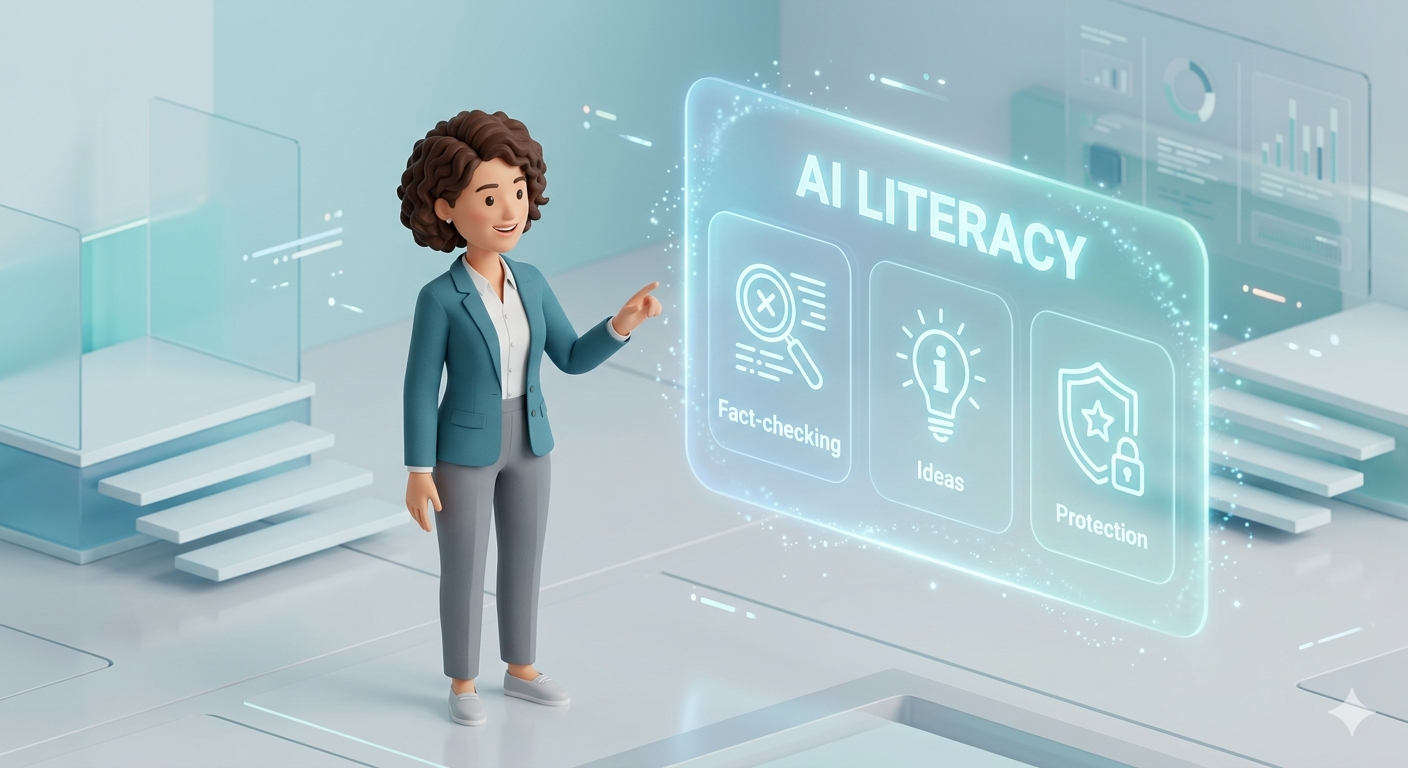
AI can suffer from hallucinations—a fancy word for when the system confidently makes up facts, dates, or legal citations that don’t exist.
- The Golden Rule: Never copy-paste AI output for important tasks without a manual fact-check. AI is a great drafter, but a terrible final editor.
4. 🔐 Digital Safety and Ethics
In 2026, data is the most valuable currency. When you interact with a free AI tool, your input might be used to train future models.
- Privacy Check: Never share passwords, proprietary company secrets, or sensitive personal medical info with a public AI chatbot.
🔥 Next-Level AI Skills for 2026
As technology evolves, the challenges become more subtle. To stay ahead, you must develop a “critical eye.”
🎭 Spotting “Synthetic” Content (Deepfakes)
We’ve entered an era where “seeing is no longer believing.” AI can now generate hyper-realistic videos, mimic voices of loved ones, and create photos of events that never happened.
- Pro Tip: Look for inconsistencies in lighting, strange blurring around the edges of hair, or unnatural blinking patterns. Always verify shocking news through multiple established sources.
📰 Navigating the Hype Cycle
Every week, a new “world-changing” AI tool is released. Some are revolutionary; many are just “wrappers” (simple interfaces over existing tech).
- Ask yourself: Does this tool solve a specific problem for me, or is it just a novelty?
🧩 Tasks vs. Jobs
There is a lot of fear-mongering about AI “taking jobs.” In reality, AI replaces tasks, not entire roles. A graphic designer who uses AI to generate ideas is 10x faster than one who doesn’t. AI is a tool of augmentation, not just replacement.
💡 Why AI Literacy Matters
🛡️ Your Shield: Protection
AI literacy is your best defense against 2026-era scams. Whether it’s an AI-generated voice scam or a deepfake phishing email, knowing how the tech works makes you much harder to fool.
⚡ Your Sword: Power
Those who are AI-literate can:
- Work Faster: Automate boring administrative tasks.
- Create More: Turn a simple idea into a video, song, or code in minutes.
- Increase Value: In the job market, “AI-augmented professional” is the most sought-after title.
📌 Final Thoughts
The gap in the modern world isn’t between “humans and robots”—it’s between those who know how to use AI and those who are afraid of it.
👉 AI is not replacing humans. People who understand AI will replace those who don’t.
Start small. Try a new tool this week. Ask it to help you meal plan, summarize a long article, or explain a complex topic to you like you’re five. Stay curious, stay skeptical, and keep learning.
💬 The future belongs to the curious. Stay smart. Stay ahead.