
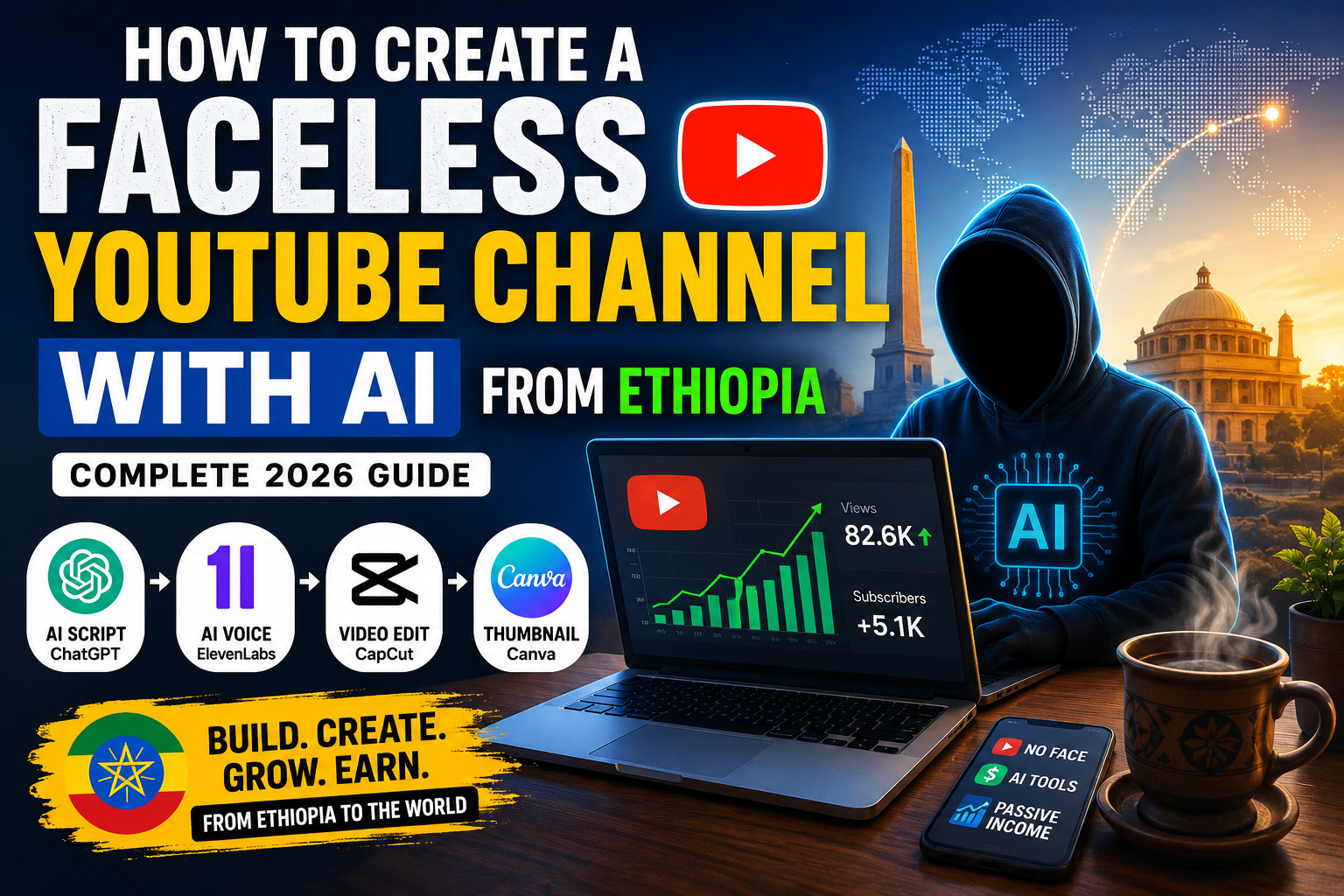
If you’ve searched for “how to start a faceless YouTube channel,” you’ve probably noticed something: almost every guide out there is written for creators in the US, UK, or India. They assume you have a fast fiber connection, an international credit card, and zero language barrier. None of that reflects the reality of building a channel from Addis Ababa, Adama, or Jimma.
This guide is different. It’s written specifically for Ethiopian creators who want to build a faceless YouTube channel with AI — using free tools, mobile phones, limited data bundles, and local payment realities. By the end, you’ll have a complete roadmap: from choosing a low-competition niche to getting paid through Payoneer.
1. Why Ethiopia Is the Perfect Place to Start a Faceless Channel
A faceless channel uses AI-generated voiceovers, stock or AI visuals, and screen recordings instead of your face on camera. This matters even more in Ethiopia, where camera-based content faces real friction: unreliable lighting setups, cultural hesitance about being on camera, and the extra data cost of filming and uploading high-resolution video of yourself.
With a faceless format, you skip all of that. You write or generate a script, turn it into a voiceover, pair it with simple visuals, and upload — all from a mid-range smartphone. Ethiopia also has a structural advantage most guides never mention: massive untapped language markets. English-language YouTube is saturated. Afaan Oromo and Amharic YouTube are not.
2. The Ethiopian YouTube Opportunity — Low Competition, Growing Audience
Three forces make this the right moment to start:
- Low competition in local languages. English “faceless finance” or “faceless motivation” channels number in the hundreds of thousands. Equivalent Afaan Oromo or Amharic channels number in the low hundreds — many run by hobbyists, not strategists.
- A fast-growing domestic audience. Smartphone and mobile data adoption in Ethiopia continues to expand year over year, and YouTube is increasingly the default entertainment and information app for young Ethiopians.
- A diaspora market of 3M+ globally. Ethiopians and Ethiopian-Americans, Ethiopian-Europeans, and Ethiopian communities across the Gulf and Africa are a highly engaged, nostalgia-driven, and monetizable audience. Diaspora viewers often watch longer, comment more, and come from countries with higher CPM (cost-per-mille) rates than Ethiopia itself — which directly increases your AdSense revenue per view.
This combination — low local competition plus a high-value diaspora audience — is the core opportunity this guide is built around.
3. Best Niches for Ethiopian Faceless Channels
Not all niches are equal. Here’s a breakdown of the strongest opportunities right now, ranked by competition level and audience potential.
| Niche | Language | Competition Level | Audience | Monetization Potential |
|---|---|---|---|---|
| Afaan Oromo educational content | Afaan Oromo | Very Low | Oromia + diaspora | Medium-High (growing fast) |
| Amharic self-improvement & motivation | Amharic | Low-Medium | Domestic + diaspora | High |
| Ethiopian tech news & AI explained | Amharic/English | Low | Young urban Ethiopians | Medium-High |
| Ethiopian business & finance | Amharic/English | Low | Domestic + diaspora entrepreneurs | High |
| Ethiopian history & culture | English/Amharic | Medium | Global diaspora (3M+) | High (diaspora CPM) |
A note on Afaan Oromo content: this is arguably the single biggest opportunity in this list. Oromo is spoken by of millions of people, yet dedicated educational and self-improvement channels in the language are still scarce on YouTube. A consistent, well-produced Afaan Oromo channel can realistically outrank established channels within months simply because so few exist.
Ethiopian history and culture deserves special mention for diaspora targeting — think videos like “The Untold Story of the Battle of Adwa” or “Ethiopian Coffee Ceremony Explained for the World.” These travel well internationally, get shared across diaspora Facebook and Telegram groups, and pull in viewers from the US, Europe, and the Gulf, where ad rates are significantly higher than in Ethiopia.
For a deeper breakdown of high-CPM niches beyond this list, see our guide, YouTube Niche Ideas 2026: High CPM Faceless Channels.
4. Complete AI Production Workflow (Mobile-Friendly Version)
This is the exact four-tool workflow, and every tool here has a free tier that works on Android and iOS.
Step 1: Write the Script with ChatGPT
Open ChatGPT in your mobile browser or app. Ask it to write a 5–8 minute video script on your chosen topic, in a conversational tone, with a strong hook in the first 15 seconds. If your niche is Amharic or Afaan Oromo, you can ask ChatGPT to draft in English first, then translate and localize the phrasing yourself for natural flow — direct AI translation into Afaan Oromo especially can sound stiff, so a light human edit pass is worth the extra ten minutes.
Step 2: Generate the Voiceover with ElevenLabs
Paste your script into ElevenLabs. The free tier gives you enough monthly characters for several short videos. Choose a natural-sounding voice, generate the audio, and download the MP3 directly to your phone. This is the step that replaces you being on camera entirely.
Step 3: Edit the Video with CapCut
CapCut is the backbone of mobile-first faceless production — it’s free, built for phones, and widely used across Ethiopia already for social content. Import your voiceover, add stock footage or simple text-on-screen visuals, sync captions (CapCut can auto-generate them), and export in 1080p.
Step 4: Design the Thumbnail with Canva
Use Canva‘s mobile app to build a thumbnail with bold text, high contrast, and a clear promise (“How Ethiopians Are Using AI to Earn in 2026”). Canva’s free templates are more than sufficient — you don’t need Canva Pro to start.
None of these four tools require an international credit card to use on the free tier, which matters enormously in Ethiopia, where signing up for Western SaaS products is often the first barrier creators hit.
5. Setting Up Your YouTube Channel from Ethiopia
- Create a Google account if you don’t already have one.
- Go to YouTube and click “Create a channel” — choose a name that reflects your niche and is easy to spell in both English and your target local language.
- Write a channel description that clearly states your niche and upload schedule.
- Add channel art (Canva has free YouTube banner templates).
- Turn on two-factor authentication — this protects your channel and is required before you can apply for monetization features later.
- Upload 3–5 videos before promoting the channel anywhere, so new visitors see a real library, not an empty page.
6. YouTube Monetization for Ethiopians — AdSense via Payoneer
This is the part most guides skip, and it’s the part Ethiopian creators actually ask about most.
Google AdSense does not send payments directly to Ethiopian bank accounts in most cases. The practical workaround used by thousands of Ethiopian creators and freelancers is Payoneer:
- Once your channel meets YouTube Partner Program requirements (1,000 subscribers and 4,000 watch hours in the past 12 months, or 10 million Shorts views in 90 days), apply for monetization inside YouTube Studio.
- Sign up for a free Payoneer account — Payoneer supports Ethiopian users and gives you a receiving account you can link to AdSense.
- In your AdSense settings, add Payoneer as your payment method using the receiving account details Payoneer provides.
- Once your AdSense balance hits the payment threshold, funds transfer to Payoneer, and you withdraw to a local bank account or Payoneer card.
Processing times and any local withdrawal fees can change, so always check current details directly on Payoneer’s site before relying on a specific number.
7. Data and Internet Management for Video Uploads
This is the single biggest practical difference between an Ethiopian creator’s workflow and a Western one — so plan around it deliberately:
- Edit at 1080p, not 4K. 4K files are 3–4x larger for uploads with no meaningful benefit on mobile-watched content.
- Upload during off-peak hours (late night or early morning) when networks are less congested and uploads are less likely to fail midway.
- Use Wi-Fi where available — cafés, offices, or shared connections — for uploads specifically, even if you script and edit on mobile data.
- Compress before uploading. CapCut’s export settings let you balance quality and file size — a “medium” export is usually indistinguishable to viewers but uploads noticeably faster.
- Batch your work. Write and voice multiple scripts in one sitting, then edit and upload in a separate, dedicated session, so you’re not burning data on back-and-forth revisions.
- Buy a dedicated data bundle for upload days rather than pulling from your general daily bundle — it keeps your production costs predictable.
8. Your First 30 Days: A Realistic Ethiopian Creator Schedule
Week 1 — Setup and first video Pick your niche, set up your channel, write and produce your first video end-to-end using the four-tool workflow.
Week 2 — Build a rhythm Publish 2 videos. Study which titles and thumbnails get more clicks. Start a swipe file of successful videos in your niche (local and international) for structure ideas — not for copying content.
Week 3 — Increase consistency Publish 2–3 videos. Begin cross-posting short clips to Telegram and Facebook groups relevant to your niche, especially diaspora groups if your content targets them.
Week 4 — Review and refine Publish 2–3 videos. Check YouTube Studio analytics: average view duration, click-through rate, and traffic sources. Double down on whatever topic or format performed best.
Realistic target by day 30: 8–10 published videos, a repeatable production process, and a clear signal of which specific sub-topic within your niche your audience responds to.
9. Case Study: Hypothetical Afaan Oromo Finance Channel
To illustrate how this could play out, here’s a hypothetical, illustrative projection — not a guarantee — for an Afaan Oromo personal finance channel following this workflow consistently.
- Month 1: 8 videos published, under 500 subscribers, focus entirely on finding a content angle that resonates (e.g., “saving money as a young professional in Ethiopia”).
- Month 2: 8–10 videos, subscriber growth accelerates as 1–2 videos start ranking in Afaan Oromo search results due to low competition.
- Month 3: Consistent uploads, first videos crossing meaningful view counts, channel begins approaching YouTube Partner Program thresholds.
- Month 4–6: If the channel reaches monetization eligibility, AdSense is applied for and linked to Payoneer; diaspora viewership starts contributing disproportionately to revenue due to higher CPMs abroad.
This scenario assumes consistent uploads, reinvested learning from analytics, and no guarantee of virality — real results vary widely by niche, execution, and luck.
Mobile Production Checklist
- Niche chosen with a clear language and audience target
- Google account and YouTube channel created
- ChatGPT app or mobile browser bookmarked for scripting
- ElevenLabs free account set up for voiceovers
- CapCut installed and export settings configured for 1080p
- Canva mobile app installed with a thumbnail template saved
- Off-peak upload time identified based on your network
- Payoneer account created (even before you’re monetized, so it’s ready)
- First 3 video topics outlined in advance
Key Takeaways
- Ethiopia’s biggest faceless YouTube advantage is language: Afaan Oromo and Amharic niches have far less competition than English ones.
- The Ethiopian diaspora (3M+ globally) is a high-value audience that can lift your average CPM significantly.
- A four-tool free workflow — ChatGPT, ElevenLabs, CapCut, Canva — covers scripting to thumbnail entirely on mobile, without needing an international card.
- AdSense payments reach Ethiopia in practice through Payoneer, not direct bank transfer.
- Managing data costs (1080p exports, off-peak uploads, Wi-Fi for uploads) is as important to your workflow as the content itself.
- Consistency over the first 30 days matters more than perfection — aim for 8–10 published videos in your first month.
Frequently Asked Questions
Can Ethiopians receive YouTube payments? Yes, but not usually via direct bank deposit from Google AdSense. The common route is linking AdSense to a Payoneer account, then withdrawing from Payoneer to a local Ethiopian bank account or Payoneer card once you meet YouTube’s monetization thresholds.
What internet speed do I need to run a faceless channel from Ethiopia? You don’t need a fast connection for production — scripting, voice generation, and editing all happen on your phone using stored data and local processing. You mainly need enough bandwidth to upload a compressed 1080p video, which is manageable even on a moderate mobile data connection if you upload during off-peak hours.
Which AI tools work on mobile in Ethiopia? ChatGPT (via browser or app), ElevenLabs (mobile browser), CapCut (native mobile app), and Canva (native mobile app) all work on Android and iOS and all offer free tiers that don’t require an international credit card to get started.
Do I need to speak on camera at all? No — that’s the entire point of a faceless channel. Your voice can even be fully AI-generated through ElevenLabs, so you don’t need to record your own voice if you’d rather not.
How long until an Ethiopian faceless channel can be monetized? There’s no fixed timeline — it depends on niche competition, upload consistency, and content quality. Some low-competition Afaan Oromo or niche Amharic channels have reached YouTube Partner Program thresholds faster than saturated English niches simply because there’s less competing content to outrank.
Earnings Disclaimer
The figures, timelines, and the case study in this article are illustrative and hypothetical. They are intended to demonstrate how a workflow could progress, not to promise specific results. YouTube earnings depend on niche, consistency, audience retention, advertiser demand, and factors outside any creator’s control. MiraTech Blogs does not guarantee income, subscriber growth, or monetization approval from following this guide.
Related reading from MiraTech Blogs: