
Published: June 2026 | Updated: July 2026 | By the MiraTech Blogs Team
“The office was never the work. It was just the container. AI has broken the container — and what’s left is pure, location-independent human potential.”
Table of Contents
- Introduction: The Workplace Will Never Be the Same
- The State of Remote Work in 2026
- How AI Is Changing Remote Work — Category by Category
- The New Remote Work Skills Stack
- What Business Leaders Must Understand Right Now
- The Emerging Market Opportunity
- The Dark Side — Challenges We Can’t Ignore
- What the Workforce Looks Like in 2030
- Recommended AI Tools for Remote Workers
- Frequently Asked Questions
- Key Takeaways
Introduction: The Workplace Will Never Be the Same {#introduction}
In 2020, the world was forced into a remote work experiment nobody asked for.
In 2026, the world has made a permanent choice.
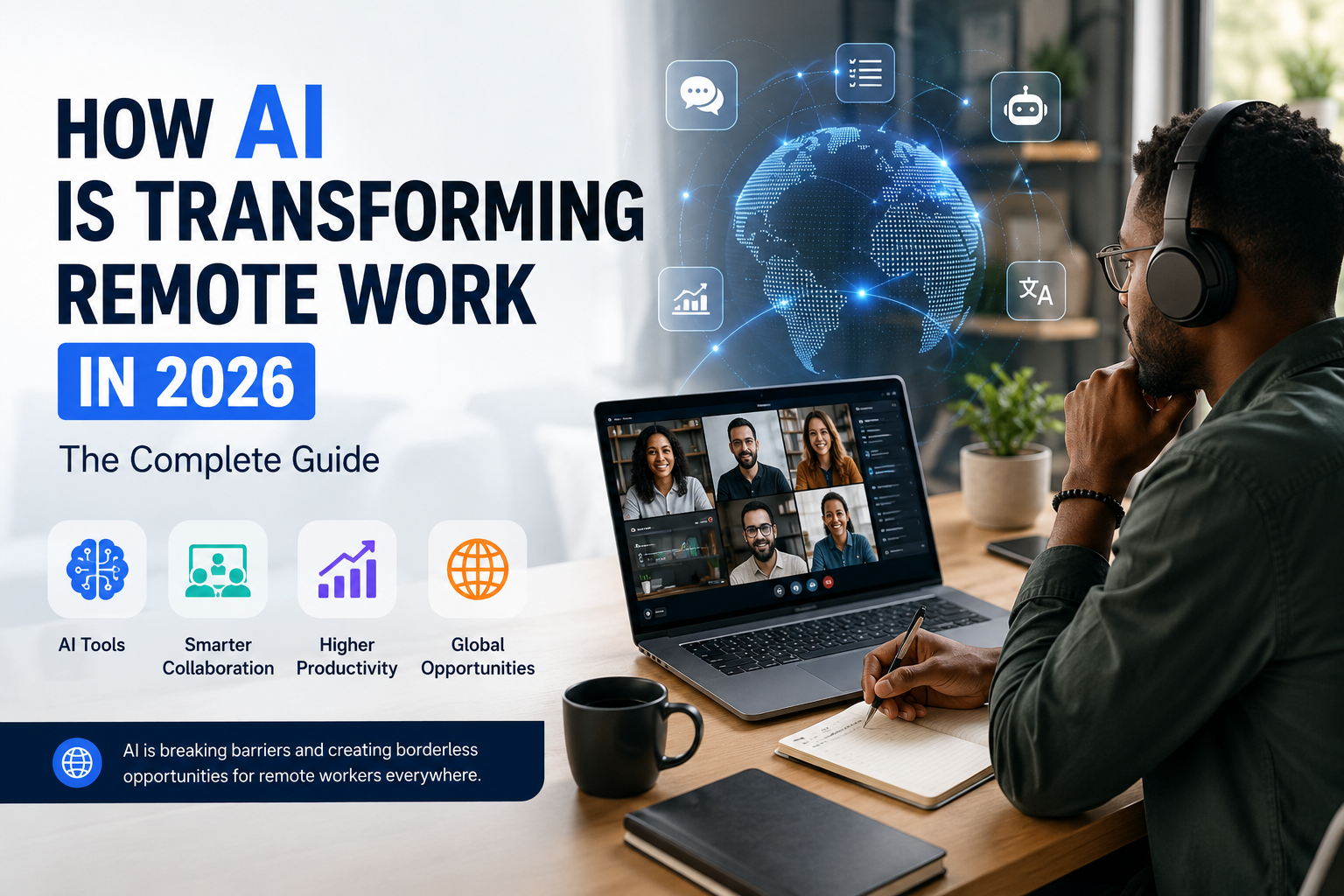
Over 32% of the global workforce now works remotely or in a hybrid arrangement — and that number keeps climbing. But here’s what most headlines miss: the remote work revolution didn’t just change where we work. Artificial intelligence is now fundamentally changing how we work, what we do, and who gets hired — regardless of borders.
A developer in Nairobi can now collaborate in real time with a team in Amsterdam, with AI handling translation, meeting summaries, timezone scheduling, and even code reviews. A content strategist in Addis Ababa can compete — and win — against agencies in New York, powered by the same AI tools at a fraction of the cost.
This is not the future. This is happening right now.
In this guide, we’ll cover:
- How AI is transforming remote work across every industry
- The specific tools leading this revolution
- The new skills remote workers need to stay relevant
- What business leaders must do to prepare
- What this all means for the global workforce — especially in emerging markets
Let’s dive in.
Part 1: The State of Remote Work in 2026 {#part-1}
The Numbers Don’t Lie
The remote work landscape in 2026 looks dramatically different from even three years ago:
- 1.8 billion people globally now have access to digital work platforms
- 67% of knowledge workers say they would quit their job before returning to a five-day office week
- Remote job postings have grown by 340% since 2020 on platforms like LinkedIn and Upwork
- Companies with fully remote policies report 18% higher employee retention than office-only firms
- The global remote work market is now valued at over $1.5 trillion in economic output
But perhaps the most significant shift isn’t in the numbers — it’s in the infrastructure. The tools that make remote work possible have evolved from basic video calls and shared documents into a sophisticated, AI-powered ecosystem that is, in many ways, more productive than the traditional office ever was.
The Three Eras of Remote Work
Era 1: Emergency Remote (2020–2021) Remote work out of necessity. Zoom calls, Slack messages, makeshift home offices. Productivity suffered. Companies scrambled.
Era 2: Hybrid Experimentation (2022–2023) Companies tried to find balance. Some required three days in office. Others went fully remote. The “great resignation” showed employees had leverage. Culture wars erupted between CEOs and workers.
Era 3: AI-Native Remote Work (2024–present) This is where we are now. AI tools have solved most of the friction points of remote work — communication gaps, collaboration barriers, productivity tracking, onboarding, and management. Remote work is no longer a compromise. For many knowledge workers, it’s now the superior way to work.
Part 2: How AI Is Changing Remote Work — Category by Category {#part-2}
1. Communication & Collaboration
The biggest complaint about remote work has always been communication: misaligned timelines, endless email threads, Zoom fatigue, cultural misunderstandings. AI has tackled each of these head-on.
AI meeting assistants like Otter.ai, Fireflies.ai, and Microsoft Copilot now:
- Transcribe meetings in real time with 98%+ accuracy
- Generate automatic summaries and action-item lists
- Flag decisions made and follow-ups assigned
- Translate conversations across 40+ languages simultaneously
Real-world impact: A remote marketing team that previously held 12 hours of meetings per week now holds 4 hours — because AI pre-summarizes updates and flags only items that require human discussion.
AI-powered async tools like Loom AI and Notion AI allow teams to communicate across time zones without anyone losing sleep. A manager in London records a three-minute briefing; AI transcribes, translates, and highlights key points for a team member in Manila reading it at 9 a.m. local time.
2. Project Management & Productivity
Traditional project management tools required manual updates, status meetings, and constant human oversight. AI has automated the mundane and amplified the meaningful.
Tools leading this shift:
- ClickUp AI — generates project plans, assigns tasks based on team capacity, and predicts deadline risks before they become crises
- Monday.com AI — analyzes historical project data to recommend resource allocation
- Asana Intelligence — flags bottlenecks in workflows before they cause delays
- Linear AI — for software teams, auto-categorizes and prioritizes bug reports and feature requests
Project managers who once spent 40% of their time on administrative updates now spend that time on strategic decisions — because AI handles the status reports, dependency tracking, and progress dashboards automatically.
3. Hiring & HR in the Remote Age
Human Resources has been one of the most disrupted departments in the AI-remote work revolution.
Talent acquisition: Tools like HireVue, Workday AI, and Greenhouse use AI to screen thousands of applications, conduct preliminary video interviews, assess candidate competency through language analysis, and reduce time-to-hire from 45 days to under 14 days in many organizations.
Onboarding: AI-powered platforms like BambooHR and Rippling create personalized onboarding journeys for remote employees — interactive guides, automated document collection, AI chat assistants that answer common questions 24/7, and structured 30-60-90 day plans generated automatically.
Performance management: Instead of annual reviews that capture a single moment in time, AI tools now enable continuous performance tracking based on output metrics, project completion rates, peer feedback, and communication patterns — giving managers real-time, unbiased data.
For HR professionals: Your role is evolving from administrator to strategic advisor. The companies winning the remote talent war are those using AI to remove friction from the employee experience while using human judgment for culture, empathy, and leadership.
4. Customer Service & Client Work
For remote workers in client-facing roles — account managers, customer success, sales — AI has fundamentally changed the daily workflow.
AI CRM tools like Salesforce Einstein and HubSpot AI:
- Analyze customer emails and flag sentiment changes before a client churns
- Generate personalized follow-up messages based on conversation history
- Predict which deals are most likely to close and prioritize accordingly
- Automatically update deal stages based on email and call activity
Remote customer service teams powered by AI can now handle 3–4x more client interactions at the same quality level, enabling smaller teams to serve larger client bases without sacrificing relationship quality.
5. Creative & Knowledge Work
For writers, designers, marketers, analysts, and developers — the largest category of remote workers — AI has become the most powerful productivity multiplier in history.
- Writers and content creators use ChatGPT, Claude, and Gemini to draft, edit, research, and optimize content at 5–10x their previous output.
- Designers use Midjourney, Adobe Firefly, and Canva AI to produce high-quality visuals in minutes instead of hours.
- Data analysts use tools like Julius AI and Tableau AI to query datasets in plain English, generate visualizations, and produce insight reports automatically.
- Software developers use GitHub Copilot, Cursor AI, and Amazon CodeWhisperer to write, debug, and document code significantly faster — with studies showing 55% productivity gains among developers using AI coding assistants.
The common thread: AI doesn’t replace these workers. It removes the slow, low-value parts of their work so they can focus on strategy, creativity, and judgment — the things that actually create competitive advantage.
6. Finance, Legal, and Back-Office Work (New)
AI has also crept into functions that once seemed immune to remote-first, automation-heavy workflows:
- Bookkeeping and invoicing — tools like QuickBooks AI and Xero’s AI assistant auto-categorize expenses, flag anomalies, and generate financial summaries in seconds.
- Contract review — AI legal assistants (e.g., Ironclad AI, Spellbook) redline contracts, flag risky clauses, and cut first-pass review time by more than half.
- Compliance monitoring — AI systems continuously scan for regulatory changes relevant to a distributed workforce operating across multiple jurisdictions.
This matters for remote work because it means even traditionally office-bound, paperwork-heavy roles can now be done — and done well — from anywhere.
7. Learning & Professional Development (New)
AI-powered learning platforms (Coursera Coach, LinkedIn Learning AI, Khanmigo) now personalize upskilling paths for remote workers:
- Adaptive course recommendations based on skill gaps in your current role
- AI tutors that answer questions in real time instead of waiting for office hours
- Auto-generated practice exercises and instant feedback
For remote teams without a physical training room, this closes the gap between in-office mentorship and distributed learning.
Part 3: The New Remote Work Skills Stack
Here’s a truth that many career guides aren’t saying clearly enough: the remote workers who thrive in 2026 are not the ones with the most technical skills. They are the ones who know how to work with AI most effectively.
This is called AI literacy — and it’s the most valuable professional skill of this decade.
The 5 Core Skills Remote Workers Need Now
- Prompt Engineering — The ability to communicate with AI tools effectively. A marketer who writes a well-structured prompt gets dramatically better results than one who types vague questions. This is learnable in days and pays dividends for years.
- AI Tool Fluency — Knowing which AI tool to use for which task, and how to integrate multiple tools into a seamless workflow. The best remote workers in 2026 have a personal AI stack they’ve mastered, just like professionals of the 1990s mastered Word and Excel.
- Critical Thinking & Judgment — As AI handles more execution tasks, human judgment becomes more valuable, not less. The ability to evaluate AI output, spot errors, make ethical calls, and apply nuanced thinking is now a premium skill.
- Async Communication — The ability to communicate clearly without real-time conversation. In a global remote team, your writing is your presence.
- Digital Self-Management — The discipline to manage your own time, energy, and priorities without external supervision. The workers who succeed replace office structure with personal systems, not willpower.
Part 4: What Business Leaders Must Understand Right Now
The Global Talent Pool Is Now Your Competitive Advantage
Remote work plus AI has broken geographical hiring constraints in both directions. You can now hire the best analyst in the world, not just the best analyst within commuting distance — but your competitors can too.
Companies that embrace this reality are building distributed dream teams — hiring senior talent in lower cost-of-living regions, enabling world-class output at sustainable operational costs.
AI Is Not Replacing Your Team. Outdated Processes Are.
The companies most threatened by AI are not those with human workforces. They are those with manual, inefficient processes that AI-enabled competitors can execute in a fraction of the time and cost.
The correct response to AI is to:
- Identify which tasks in your operations are ripe for AI automation
- Retrain your people to work alongside those tools
- Redirect human talent toward higher-value, judgment-intensive work
- Build a culture of continuous learning around new AI capabilities
Trust Is the New Management Currency
The #1 challenge of remote work is not productivity — it’s trust.
Old-school management was built on visibility: I can see you at your desk, therefore you are working. Remote work breaks that model entirely.
The AI-powered alternative is outcome-based management: I don’t care where you are or when you work. I care whether the deliverable is excellent and on time.
AI tools now make this practical at scale. Real-time dashboards, automated progress reports, and output-based performance metrics give managers the visibility they need without surveillance — and give employees the autonomy they deserve.
Part 5: The Emerging Market Opportunity
This section is especially important for readers in Africa, Southeast Asia, and other emerging markets — because the AI-remote work revolution may be the single greatest economic opportunity your generation has ever seen.
Why Emerging Market Remote Workers Are Uniquely Positioned
- Cost advantage meets quality parity. AI tools have closed the quality gap between a well-equipped professional in Addis Ababa and one in Amsterdam. The salary differential, however, remains enormous — creating massive value for both employer and employee.
- Growing digital infrastructure. Across Africa, mobile internet penetration, fiber expansion, and satellite platforms are making high-quality remote work possible in cities and towns that were digitally isolated just five years ago.
- Young, adaptable workforce. Africa’s median age is 19. This generation is growing up digital-first, AI-fluent, and globally connected. They are not unlearning the office — they never had to.
- In-demand skill gaps. Global companies are actively searching for AI-literate remote talent in data analytics, digital marketing, software development, content creation, and customer success. These skills are learnable. The demand is now.
Platforms Opening Doors
- Upwork & Fiverr — freelance work in any skill category
- Toptal & Andela — premium remote placement for top tech talent
- Remote.com & Deel — enable companies globally to legally hire and pay remote workers in any country
- LinkedIn — the primary platform for remote job discovery and professional credibility
If you’re in an emerging market and reading this: the infrastructure exists, the tools exist, and the demand exists. The barrier is no longer geography. It is skills, credibility, and the courage to apply.
Part 6: The Dark Side — Challenges We Can’t Ignore
No honest analysis of AI and remote work is complete without acknowledging the genuine challenges.
Job Displacement Is Real
AI is automating entire job categories, not just tasks. Data entry, basic customer support, routine content writing, simple graphic design, and entry-level accounting roles are shrinking globally.
This is not cause for panic, but it is cause for urgency. Workers in vulnerable roles need to proactively upskill. The safest jobs in the AI era combine human judgment, creativity, and emotional intelligence with AI tool proficiency.
The Isolation Problem
Remote work without strong social design leads to loneliness, disconnection, and mental health challenges. AI can schedule your meetings and manage your tasks — but it cannot replace human belonging.
The best remote-first companies invest heavily in:
- Regular in-person retreats (2–4 times per year)
- Virtual social channels and non-work communication
- Mental health support and flexible schedules
- Strong culture documentation and values alignment
The Digital Divide
Not everyone has equal access to fast internet, quality devices, and AI tools. The remote work revolution risks deepening inequality if access is not democratized. Governments, NGOs, and companies all have a role to play through infrastructure investment, digital literacy programs, and equitable hiring practices that look beyond polished LinkedIn profiles.
Privacy and Surveillance Concerns
Some companies have responded to remote work by deploying employee monitoring software — keystroke trackers, screenshot tools, productivity scores. This approach is counterproductive. It destroys trust, signals poor management, and drives away exactly the high performers companies most want to retain. AI-powered management should empower, not surveil.
Part 7: What the Workforce Looks Like in 2030
Looking four years ahead, here’s where credible research and visible trends point:
- The four-day work week becomes standard for knowledge workers. AI productivity gains make it economically viable. Companies that adopt it first gain a recruiting advantage.
- AI teammates become normal. Every professional will work alongside AI agents that handle research, scheduling, drafting, and analysis. “Working with AI” will be as unremarkable as “using a spreadsheet.”
- Physical location becomes irrelevant for most knowledge work. Top talent will work from wherever they choose, and companies that restrict this will lose the talent competition.
- New job categories will emerge — AI trainers, prompt engineers, AI ethics officers, digital experience designers, human-AI collaboration specialists.
- The skills premium shifts upward. Low-skill routine work will continue to automate. Mid-skill work will require AI augmentation. High-skill, judgment-intensive work will be more valuable than ever.
- Emerging markets will close the gap. By 2030, Africa, Southeast Asia, and Latin America will contribute a significantly larger share of the global remote workforce, accelerated by AI tools that lower the barriers to quality output.
Recommended AI Tools for Remote Workers in 2026
| Category | Tool | Best For |
|---|---|---|
| Meeting AI | Otter.ai / Fireflies | Transcription & summaries |
| Writing AI | ChatGPT / Claude | Drafting, editing, research |
| Design AI | Canva AI / Adobe Firefly | Visuals & graphics |
| Project Management | ClickUp AI | Task & workflow automation |
| Code AI | GitHub Copilot | Development productivity |
| HR/Onboarding | Rippling AI | Remote team management |
| Analytics | Julius AI | Data querying & insights |
| Async Video | Loom AI | Team communication |
| Finance & Contracts | QuickBooks AI / Ironclad AI | Bookkeeping & contract review |
| Learning | Coursera Coach | Personalized upskilling |
Frequently Asked Questions {#faq}
Q: Will AI replace remote workers? AI will replace specific tasks and some roles, but it will also create new ones. Remote workers who use AI proactively are far more secure than those who ignore it. The threat isn’t AI itself — it’s being outcompeted by someone who uses AI better than you.
Q: What industries offer the most remote AI-powered work in 2026? Technology, digital marketing, content creation, data analytics, customer success, finance, consulting, education, and healthcare (telehealth) are the highest-opportunity remote fields today.
Q: How do I start building remote work skills from scratch? Start with one area: learn the AI tools relevant to your field, build a portfolio of work you can show remotely, create a professional presence on LinkedIn and Upwork, and apply consistently. The first remote opportunity is the hardest to get — after that, momentum builds.
Q: Is remote work sustainable long-term for mental health? Yes, with the right structure. Separate your workspace, maintain regular social contact, set working hours, and build non-screen activities into your routine. Remote work offers immense lifestyle freedom, but it requires intentional design to stay healthy and motivated.
Q: What does this mean for workers in Africa specifically? The opportunity is enormous and largely untapped. Global companies are actively seeking AI-literate remote talent. Ethiopian, Kenyan, Nigerian, Ghanaian, and South African professionals with strong digital skills are increasingly competitive for remote roles that pay in USD or EUR — a transformative income opportunity given local cost-of-living.
Key Takeaways
- Remote work has entered its third era — AI-native remote work — where AI solves the core frictions of distributed work
- AI is transforming every dimension of remote work: communication, project management, hiring, customer service, finance, and creative output
- The most valuable skill for remote workers in 2026 is AI literacy — the ability to work with AI tools effectively
- Business leaders must shift to outcome-based management and embrace the global talent pool
- Emerging market workers have an unprecedented opportunity as AI closes the quality gap while geographical salary differentials remain
- Real challenges exist: job displacement, isolation, the digital divide, and surveillance — all requiring a proactive response
- By 2030, AI teammates, four-day work weeks, and location-agnostic careers will be the norm for knowledge workers
Was this article useful?
Share it with a colleague navigating the new world of work.
Subscribe to MiraTech Blogs for weekly deep-dives on AI, technology, and digital income strategies.
— MiraTech Blogs Team