
“The most dangerous position in your career this year isn’t being replaced by AI. It’s being outpaced by a colleague who has simply learned to use AI better than you. One of those outcomes is beyond your control. The other is entirely up to you.”
Introduction: The AI Skills Gap Has Arrived
Here’s something most career blogs won’t tell you straight: if you aren’t actively building AI skills right now, you’re already behind. Not in five years. Now. And the distance between people who take action and people who wait keeps growing every month.
By 2026, artificial intelligence isn’t a niche tool reserved for software engineers. It’s woven into healthcare, banking, education, marketing, law, agriculture, design, and journalism. The old question — “will AI change my industry?” — has already been answered. The question that actually matters today is simpler: are you working alongside AI, or are you being replaced by someone who is?
This guide is for professionals who feel that pressure. For students who want to graduate job-ready. For career-changers hunting for skills with real payoff. And for anyone who has searched “AI skills to learn” and drowned in vague, outdated advice.
Consider this the fix — direct, current, and built specifically for 2026. Welcome to MiraTech Blogs’ complete breakdown of what to learn, why it matters, and how to do it in 90 days.
Why 2026 Marks a Turning Point
A few years ago, AI skills were simply a bonus — something that made your résumé stand out or sped up a side project. That era is over.
In 2026, AI literacy isn’t a differentiator. It’s a baseline requirement for staying employed.
Three shifts pushed things to this point:
1. The tools finally became reliable. Early AI systems were interesting but inconsistent. Today’s generation of large language models and generative platforms can competently handle large chunks of knowledge work — writing, analysis, design, coding, and research — at a quality level that changes how organizations operate.
2. Adoption crossed the tipping point. Enterprise AI deployment has surged past the halfway mark globally, and the trend line keeps climbing. Once a majority of companies embed AI into daily operations, employees who can’t use it become a liability rather than an asset.
3. The salary premium became impossible to ignore. Job postings that explicitly list AI-related skills now command noticeably higher pay than equivalent roles without them — and in fields like finance, healthcare, and technology, that premium can be substantial.
This isn’t hype. The gap is real, it’s widening, and the professionals who close it over the next year will spend the next decade building from a position of strength instead of catching up.
Numbers Worth Knowing
| Metric | Figure |
|---|---|
| Employers now screening candidates for AI literacy | Majority and rising |
| New AI-adjacent roles projected globally by 2027 | Tens of millions |
| Average salary premium for AI-skilled professionals | Significant, industry-dependent |
| Jobs expected to shift or transform due to AI by 2027 | Tens of millions |
Mindset shift: Stop asking “will AI take my job?” Start asking: “How do I become the person who uses AI so effectively that three other roles become unnecessary?” The first question breeds anxiety. The second produces a plan.
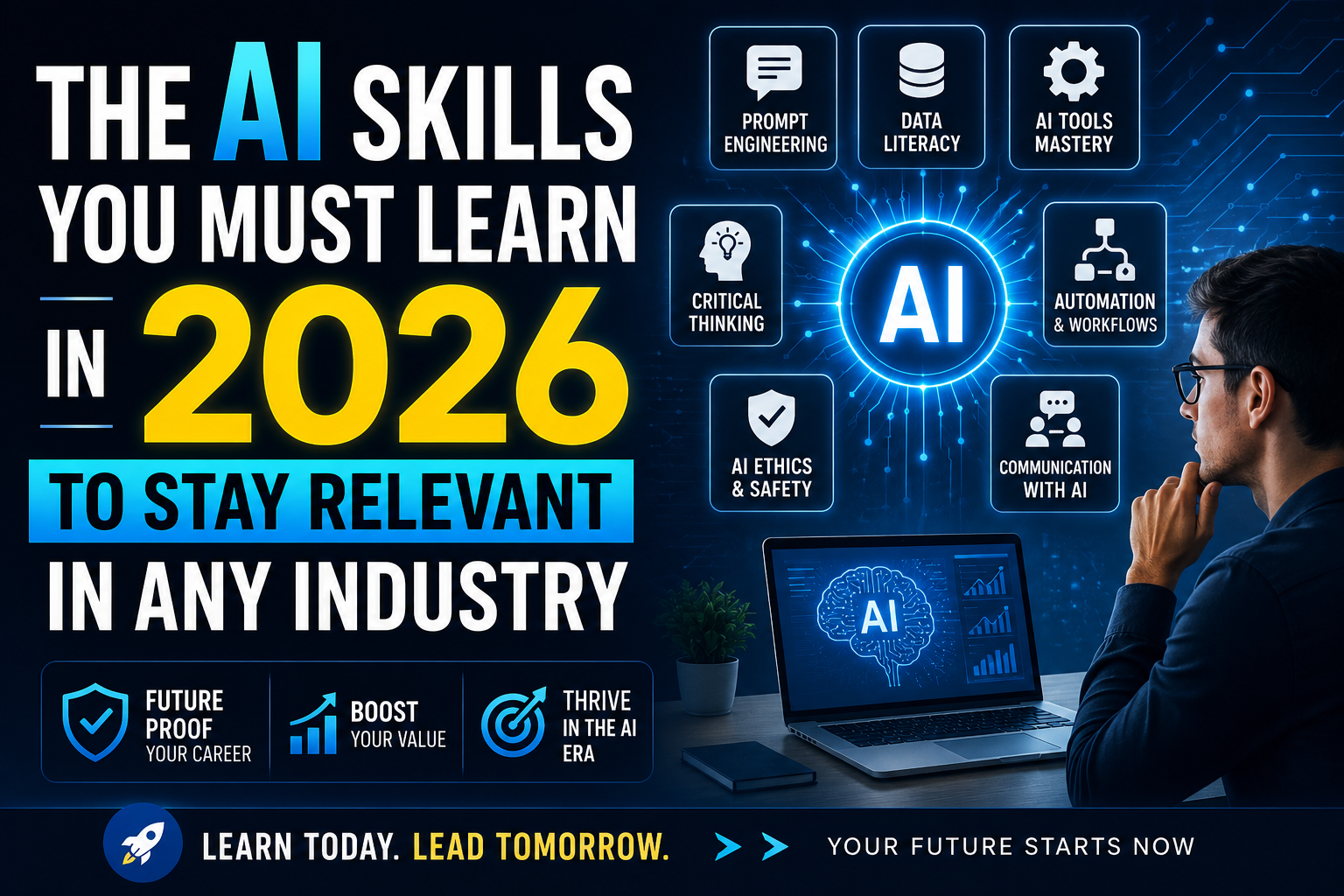
The 8 AI Skills You Need in 2026
These are ranked by urgency and how broadly they apply — starting with skills every professional needs, moving toward specialized capabilities with high earning potential.
1. Prompt Engineering
Priority: Essential — All Industries
This is the ability to communicate with AI tools in a way that produces genuinely useful output. It’s the foundational skill that multiplies the value of everything else you use AI for. A weak prompt produces generic filler. A strong one produces work you can use immediately.
Most people using ChatGPT or Claude are leaving the majority of the tool’s value untapped simply because they haven’t learned how to prompt well — a gap that’s fixable in about two weeks of deliberate practice.
A simple framework — four elements that separate casual users from power users:
- Role — Tell the AI who it should act as. “You are a senior financial analyst with 15 years of experience…”
- Context — Explain the situation. “I’m preparing a board report on a Q2 revenue decline…”
- Task — State exactly what you need. “Write a 300-word executive summary identifying the top three causes…”
- Format — Specify how the output should look. “Use bullet points, plain language, no jargon, and end with one clear recommendation.”
A vague request like “write me a marketing email” produces something you’ll rewrite for half an hour. A detailed prompt that specifies the audience, tone, product differentiator, and desired call-to-action produces copy you can send today. That gap is pure skill — and it’s learnable.
Time to learn: 1–2 weeks
2. AI Tool Fluency
Priority: Essential — All Industries
This means knowing which AI tool solves which problem, and building genuine depth with the tools relevant to your field — rather than shallow familiarity with dozens of apps. A marketer who deeply understands two or three core tools outperforms one who has briefly sampled twenty.
Resist the urge to chase every new tool launch. Build real proficiency with three to five tools that directly support your work, and treat everything else as background awareness.
Time to learn: 2–4 weeks
3. Data Literacy
Priority: Essential — All Industries
This is the ability to read, interpret, and act on data — without needing to be a data scientist. AI generates enormous volumes of insight and analytics; the professionals who can translate that output into decisions become indispensable.
Data literacy in 2026 doesn’t mean building machine learning models. It means knowing how to read a dashboard, ask the right follow-up question, and tell the difference between correlation and causation.
Time to learn: 4–8 weeks
4. AI Workflow Automation
Priority: High — Business & Operations
This involves building automated systems with no-code platforms to connect AI tools and eliminate repetitive manual work. Professionals who can design these workflows save their organizations enormous amounts of time.
You don’t need to write code. Modern no-code automation platforms let you connect apps, trigger actions, and embed AI steps — like automated summaries or draft emails — into a workflow using drag-and-drop interfaces.
Time to learn: 3–6 weeks
5. Critical Evaluation of AI Output
Priority: Essential — All Industries
As AI generates more raw content, the premium human skill becomes knowing when that output is wrong — and fixing it. AI systems still fabricate facts, miss nuance, reflect bias, and produce confident-sounding errors. Professionals who catch and correct these failures become the quality-control layer every AI-augmented team needs.
Time to learn: Ongoing
6. AI Agent Development
Priority: High — Tech & Business
This is understanding how to build and manage autonomous AI agents — systems that can research, plan, and execute multi-step tasks with minimal human input. No-code agent-building platforms have made this accessible well beyond traditional developers.
In 2026, AI agents already handle customer support queues, competitive research, social scheduling, and parts of marketing execution. Professionals who can design and manage these agents are in high demand.
Time to learn: 4–8 weeks
7. AI Ethics and Responsible Use
Priority: Growing — Governance & Compliance
This covers understanding bias, privacy, intellectual property, and the broader ethical implications of AI use at work. This isn’t a soft skill — it’s becoming a regulatory requirement in multiple regions and is increasingly built into corporate AI policy. Professionals fluent in this area are becoming essential in legal, HR, healthcare, and government roles.
Time to learn: 4–6 weeks
8. Python for AI and Automation
Priority: Growing — Technical Roles
This means basic programming applied specifically to AI tools, data processing, and automation — not full software engineering. Even learning enough Python to automate a spreadsheet task, pull data from an API, or run a simple AI workflow puts you well ahead of the average professional in almost any field.
Time to learn: 8–16 weeks
AI Skills Priority Snapshot
| Skill | Urgency | Time to Learn |
|---|---|---|
| Prompt Engineering | Critical | 1–2 weeks |
| AI Tool Fluency | Critical | 2–4 weeks |
| Data Literacy | Critical | 4–8 weeks |
| AI Workflow Automation | High | 3–6 weeks |
| Critical Evaluation of AI Output | High | Ongoing |
| AI Agent Development | High | 4–8 weeks |
| AI Ethics & Governance | Growing | 4–6 weeks |
| Python for AI | Growing | 8–16 weeks |
AI Skills by Industry: What Your Field Actually Needs
Broad AI literacy matters everywhere, but each field has its own emerging standard tools. Here’s where to focus depending on your industry.
- Healthcare: AI diagnostics, clinical NLP, patient data privacy, AI-assisted documentation, telehealth platforms
- Finance & Banking: Predictive analytics, fraud-detection AI, regulatory-document NLP, automated reporting
- Marketing: Generative content tools, AI ad targeting, personalization engines, analytics interpretation
- Legal: AI-assisted contract review, legal research automation, document summarization, compliance tools
- Education: Personalized learning platforms, AI content creation, assessment automation, AI tutoring tools
- Engineering: AI-assisted design tools, predictive maintenance, code-assist platforms, simulation AI
- Creative Industries: Generative image and audio tools, AI-assisted writing, creative direction of AI output
- Agriculture: Precision farming AI, drone data analysis, crop prediction models, climate forecasting tools
A note for African professionals: Africa’s fastest-growing sectors — agriculture, fintech, healthcare, and education — are seeing accelerated AI adoption. Professionals across Ethiopia, Kenya, Nigeria, and Ghana who build these skills now are positioning themselves at the front of a major regional wave of AI-driven growth.
Your 90-Day AI Skills Roadmap
Knowing what to learn is only half the job. Here’s a practical, structured plan to go from AI beginner to genuinely capable professional in 90 days — without quitting your job or spending a fortune.
Days 1–14: Foundation — Master One Tool Completely Pick a single AI assistant and use it daily on real work tasks. Study prompt structure. Run at least 50 varied prompting tasks across writing, research, and analysis. The goal is depth with one tool before moving to the next.
Days 15–30: Build Your Industry Stack Research the top three to five AI tools specific to your field. Trial them against real tasks from your actual job. Keep the two or three that genuinely improve your output; drop the rest.
Days 31–50: Build Data Literacy Work through a free data-analytics course focused on reading dashboards, interpreting charts, and making decisions from data — not building models.
Days 51–70: Automate One Real Workflow Choose one repetitive task and build an automation for it using a no-code platform. Connect at least two apps and include an AI step. Document what you built — this is worth more than any certificate.
Days 71–90: Build Credibility Update your professional profile with specific tools and use cases. Write a short piece describing a project you built. Pursue one or two recognized certifications. Credibility compounds — start building it before you need it.
Where to Learn: Free and Low-Cost Resources
You don’t need to spend thousands of dollars on AI education. Some of the strongest options in 2026 are free.
Certifications worth adding to your profile:
- Foundational AI literacy certificates from major cloud providers (Google, Microsoft, IBM) — free and widely recognized
- Marketing-specific AI certifications from established platforms like HubSpot
- Short, practical courses on prompt engineering and building with AI APIs from leading AI education platforms
Communities that accelerate learning:
- AI-focused subreddits and forums for news, tool discoveries, and real user experience
- LinkedIn AI communities for professional networking and industry-specific discussion
- Tool-specific Discord servers with active tutorials and early access to new features
- Local AI meetups — in Addis Ababa, Nairobi, Lagos, and other African cities, professional AI communities are forming quickly; look for them on event platforms and LinkedIn Events
What to Actually Worry About (And What Not To)
The real threat is stagnation, not AI. The professionals most at risk aren’t those doing complex thinking, creative work, or roles built on human judgment. They’re the ones who’ve stopped learning — relying on skills that haven’t evolved in a decade and hoping experience alone will protect them.
Jobs AI can’t easily touch — yet:
- Roles built on human judgment, trust, and reading complex situations (leadership, counseling, negotiation)
- Hands-on physical work (skilled trades, healthcare, construction, manufacturing)
- Genuine creative vision and original cultural insight, as opposed to content generation
- AI oversight itself — auditing, managing, and governing AI systems is one of the fastest-growing job categories
An honest warning: if your current role is mostly content generation, basic data processing, routine research, or repetitive analysis — and you aren’t actively learning to work alongside AI tools — that role is at meaningful risk over the next two to three years. That’s not speculation; it’s what hiring data and automation research consistently point to.
Conclusion: The Window Is Open — For Now
The professionals who win the next decade of their careers won’t necessarily be the most talented or most credentialed. They’ll be the ones who recognized this moment for what it is — a narrow window where early action compounds into lasting advantage — and acted on it.
The 90-day roadmap above is realistic. The resources are free or nearly free. The skills are learnable regardless of your background or current technical level.
The future doesn’t belong to AI. It belongs to the people who learn to work with it.
Start today.
Key Takeaways
- The AI skills gap is a present-day issue affecting hiring and pay in 2026, not a future risk
- Prompt engineering is the single most universal AI skill and can be learned in 1–2 weeks
- Every industry has specific AI tools becoming standard — identify and master yours early
- Data literacy, workflow automation, and AI agent development carry some of the highest earning premiums
- The 90-day roadmap takes you from beginner to credentialed practitioner using mostly free resources
- African professionals have a genuine first-mover opportunity as regional AI adoption accelerates
- The real threat isn’t AI itself — it’s being outcompeted by someone who uses it better than you do
Frequently Asked Questions
How long does it really take to become AI-skilled? Foundational skills — prompt engineering and tool fluency — can be built in two to four weeks of daily practice. A full, credentialed skill set takes about 90 days of consistent effort, with the first 30 days delivering the majority of the career benefit.
Do I need a technical background to learn AI skills? No. The most valuable and broadly applicable AI skills — prompt engineering, tool fluency, data literacy, and workflow automation — require no coding background. Python for AI is the only technical skill on this list, and it’s optional for most career paths.
Which AI certification is most valuable for job hunting in 2026? For general credibility, foundational certificates from major cloud providers work well. For technical roles, structured short courses from AI education platforms carry weight. For marketing, platform-specific certifications are useful. That said, a real portfolio project demonstrating applied AI skill will usually outweigh a certificate in an interview.
What if my employer doesn’t use AI tools yet? Build the skills anyway. Most organizations will adopt AI tools within the next year or two. Being the person who already understands AI when that shift happens is a significant career opportunity — and these skills are portable to your next role regardless.
Is it too late to start learning AI skills in 2026? No — but the early-mover advantage window is closing. What made you stand out in 2024 will be a baseline expectation by 2028. Building these skills now still puts you ahead of most of the global workforce.
Found this guide useful? Save it, share it with someone who needs it, and follow MiraTech Blogs for weekly deep-dives on AI tools, emerging technology, and digital income strategies for Africa and beyond.