
Artificial intelligence is changing how people work, how businesses operate, and what employers expect from their employees. From content creation and data analysis to software development and customer service, AI tools are becoming part of everyday professional workflows.
For job seekers and professionals, this shift creates both opportunities and challenges. You do not necessarily need to become an AI researcher or machine learning engineer to benefit from artificial intelligence. However, developing practical AI skills for career growth can help you work more efficiently, solve problems faster, and stand out in an increasingly competitive job market.
The future of work will not simply be about humans competing with AI. In many industries, the bigger opportunity will come from people who know how to work effectively with AI.
This guide explains the most important AI skills to develop in 2026, how to acquire them, and how to remain relevant as AI continues to transform the workplace.
Understanding the Future of Work
The workplace is evolving rapidly because artificial intelligence can automate repetitive tasks, analyze large amounts of information, generate content, and support decision-making.
AI is already being used across many professional fields. Marketing teams use AI for content research and campaign ideas. Developers use AI coding assistants. Analysts use AI to explore and interpret data. Customer support teams use AI-powered assistants to respond to common questions.
This does not mean every job will disappear.
Instead, many jobs are likely to change as AI becomes integrated into existing workflows. Tasks that previously required significant amounts of manual work may become automated, while employees may spend more time on strategy, creativity, communication, problem-solving, and decision-making.
AI is changing tasks, not just job titles
One of the most important things to understand about the future of work is that AI often changes individual tasks within a job rather than completely eliminating an occupation.
For example, a marketing professional may use AI to:
- Research potential customers
- Generate content ideas
- Analyze campaign data
- Create first drafts
- Personalize marketing messages
- Automate repetitive workflows
The professional still needs to understand customers, evaluate information, make strategic decisions, and ensure the final work meets business goals.
This is why developing AI skills for career growth is becoming increasingly important.
The value of human skills is also increasing
AI can generate information quickly, but it does not remove the need for human judgment.
Skills such as critical thinking, communication, creativity, leadership, emotional intelligence, and problem-solving remain extremely valuable.
The strongest professionals will combine technical AI knowledge with these human capabilities.
In other words, the future may belong to people who can combine:
AI + domain expertise + human judgment.
Essential AI Skills for Career Growth
You do not need to learn every AI technology available. Instead, focus on practical skills that can improve your productivity and create measurable value in your profession.
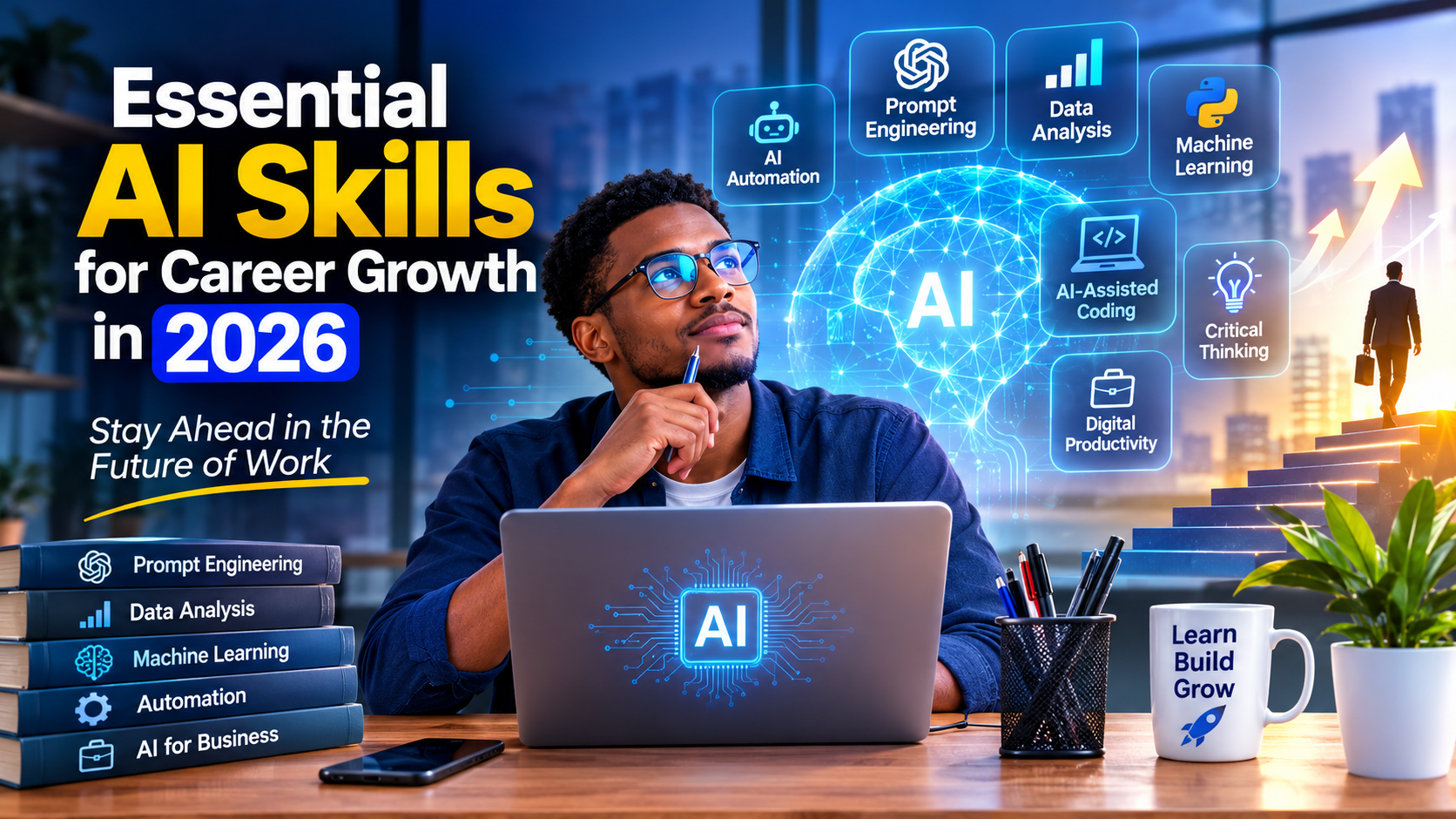
Here are some of the most important AI skills to develop in 2026.
1. AI Literacy
AI literacy is the foundation for working effectively with artificial intelligence.
It means understanding what AI can do, what it cannot do, how AI systems produce results, and how to use AI responsibly.
You should understand basic concepts such as:
- Generative AI
- Large language models
- Machine learning
- AI automation
- AI assistants
- AI limitations
- AI-generated content
- Data privacy
- AI ethics
You do not need advanced mathematics to develop basic AI literacy.
Instead, start by experimenting with widely available AI tools and learning how they can support your daily work.
For example, you can use an AI assistant to summarize documents, brainstorm ideas, analyze information, create drafts, or explain complex concepts.
The goal is not simply to know what AI is. The goal is to understand where AI can create value in your work.
2. Prompt Engineering
Prompt engineering is the ability to communicate effectively with AI systems to produce useful and reliable results.
A weak prompt may produce a generic answer, while a well-structured prompt can provide a much more useful output.
A practical prompt can include:
Role + Task + Context + Requirements + Format
For example, instead of asking:
“Write a marketing post.”
You could provide more context:
“Act as a digital marketing specialist. Create a Facebook post promoting an affordable web development service for small businesses. Target Ethiopian business owners. Use a professional but friendly tone and finish with a clear call to action.”
The second prompt gives the AI much more information about the expected result.
Prompt engineering is becoming useful across many professions because employees can use AI assistants for research, writing, planning, analysis, coding, and communication.
3. Data Analysis and Data Literacy
Data is one of the most valuable resources in modern organizations.
Professionals who can understand, analyze, and communicate data can make better decisions and provide greater value to their organizations.
AI is also making data analysis more accessible.
You should consider developing skills in:
- Excel
- SQL
- Power BI
- Python
- Data visualization
- Statistics
- Data cleaning
- Business intelligence
- AI-assisted analysis
For example, an employee might use AI to help identify patterns in a sales dataset, but they still need to understand whether those patterns make business sense.
This combination of AI and data analysis can be particularly valuable for professionals working in finance, marketing, operations, business intelligence, research, and technology.
4. AI Automation
AI becomes significantly more powerful when it is connected to workflows and business processes.
AI automation involves using AI and automation platforms to reduce repetitive manual work.
Common examples include:
- Automatically organizing information
- Generating reports
- Processing documents
- Sending personalized emails
- Updating databases
- Creating content workflows
- Automating customer support
- Connecting different business applications
Professionals who can identify repetitive tasks and design better workflows can help organizations save time and reduce operational costs.
You do not necessarily need to be an advanced programmer to start.
Tools such as workflow automation platforms and AI assistants can help beginners create useful automations.
5. AI-Assisted Software Development
Software development is another area being transformed by AI.
AI coding assistants can help developers:
- Generate code
- Explain unfamiliar code
- Debug errors
- Write tests
- Create documentation
- Refactor existing code
- Build prototypes
However, relying entirely on AI-generated code can create problems.
Developers still need strong fundamentals in programming, databases, APIs, security, testing, and software architecture.
The valuable skill is therefore not simply “using AI to code.”
It is knowing how to use AI as a development partner while maintaining technical control over the final product.
6. Machine Learning Fundamentals
Machine learning is a more advanced AI skill, but it can provide significant career opportunities for people interested in technical AI careers.
You can start by learning the fundamentals:
- Supervised learning
- Unsupervised learning
- Classification
- Regression
- Clustering
- Model evaluation
- Feature engineering
- Data preprocessing
- Model deployment
Python is one of the most useful programming languages for learning machine learning.
Libraries such as Scikit-learn, XGBoost, PyTorch, and TensorFlow can help you build practical machine learning projects.
You do not need to become an expert immediately.
Start with small projects that solve real problems and gradually increase their complexity.
7. Critical Thinking and AI Evaluation
One of the most underrated AI skills is knowing when not to trust the output.
AI systems can produce incorrect, incomplete, outdated, or misleading information.
This means professionals need to evaluate AI-generated results instead of automatically accepting them.
Before using AI output, ask:
- Is the information accurate?
- Can I verify the important claims?
- Does the result answer the actual problem?
- Is important context missing?
- Could the AI have misunderstood the question?
- Does the output create privacy or security risks?
Strong critical thinking can become a major competitive advantage because AI-generated information is becoming increasingly common.
8. Communication and Collaboration
AI skills are not limited to technical abilities. In fact, professionals also need to communicate effectively about AI.
For example, you may need to explain what an AI tool does, how an automated workflow works, or why an AI recommendation should be reviewed before it is used.
In addition, employees may need to explain AI risks to managers, clients, or colleagues who do not have a technical background.
Therefore, the ability to translate technical AI concepts into simple business language can make you extremely valuable within an organization.
How These AI Skills Can Set You Apart
Learning AI is useful, but simply listing AI tools on your CV is not enough.
Employers want evidence that you can use your skills to create results.
For example, instead of saying:
“I know ChatGPT.”
You could demonstrate:
“I created an AI-assisted workflow that reduced repetitive content preparation time.”
Instead of simply saying:
“I know Power BI.”
You could show:
“I built an interactive dashboard that helps managers monitor sales performance.”
Instead of saying:
“I understand machine learning.”
You could demonstrate:
“I developed and evaluated a machine learning model to predict customer churn.”
The difference is proof of application.
Build projects, not just certificates
Certificates can demonstrate that you completed training, but practical projects show that you can apply what you learned.
Consider building projects such as:
- AI-powered resume assistant
- Customer churn prediction dashboard
- AI content workflow
- Sales forecasting system
- Automated reporting system
- Document summarization tool
- Customer support chatbot
- Business intelligence dashboard
Publish your strongest projects through a portfolio, GitHub, LinkedIn, or your professional website.
This gives employers something concrete to evaluate.
How to Acquire AI Skills
Developing AI skills does not have to require an expensive degree or a large budget.
A practical learning strategy can be divided into several stages.
Step 1: Learn AI fundamentals
Start by understanding basic AI concepts.
Learn what generative AI, machine learning, large language models, automation, and AI agents are.
Focus on understanding practical applications rather than memorizing technical definitions.
Step 2: Choose a career direction
AI is a huge field.
Instead of trying to learn everything, connect AI with your existing career interests.
For example:
Marketing + AI
Learn AI content creation, customer research, marketing automation, analytics, and personalization.
Data + AI
Learn SQL, Python, statistics, machine learning, data visualization, and AI-assisted analytics.
Software Development + AI
Learn programming, APIs, AI coding assistants, AI application development, and automation.
Business + AI
Learn workflow automation, AI strategy, business analysis, and AI productivity tools.
Choosing a direction makes learning much more manageable.
Step 3: Practice with real problems
Do not spend all your time watching tutorials.
Use what you learn.
Find a repetitive task in your work or personal projects and ask:
“Can AI help me solve this faster or better?”
Then experiment.
This approach transforms theoretical knowledge into practical experience.
Step 4: Build a portfolio
Create projects that demonstrate your AI skills.
For each project, explain:
- What problem did you solve?
- What tools did you use?
- How did AI contribute?
- What challenges did you encounter?
- What was the result?
A well-documented project can communicate your abilities more effectively than a long list of completed courses.
Step 5: Keep learning
AI changes quickly.
New models, tools, workflows, and applications appear regularly.
You do not need to chase every new tool.
Instead, build strong fundamentals and develop the habit of experimenting with important new technologies.
Staying Relevant in an AI-Driven Job Market
The biggest mistake professionals can make is treating AI as a temporary trend.
AI adoption is likely to continue changing how organizations operate.
To stay relevant, develop a continuous learning mindset.
Combine AI with your existing expertise
You do not have to abandon your current career and become an AI engineer.
Instead, ask:
“How can AI make me better at what I already do?”
A teacher can use AI for lesson planning.
A marketer can use AI for research and content workflows.
An accountant can use AI for analysis and reporting.
A developer can use AI for coding and debugging.
A researcher can use AI for literature organization and analysis.
A business owner can use AI for customer communication and automation.
Your existing expertise becomes more powerful when combined with AI.
Focus on outcomes, not tools
AI tools will change.
A tool you use today may become less important tomorrow.
Therefore, focus on transferable capabilities such as:
- Problem-solving
- Automation
- Data analysis
- Research
- Communication
- Critical thinking
- AI evaluation
- Workflow design
These skills remain useful even when specific AI platforms change.
Develop an AI-first mindset
An AI-first mindset does not mean using AI for everything.
Instead, it means regularly asking:
“Is there a better way to solve this problem using AI?”
This mindset can help you identify opportunities for automation, productivity improvements, and innovation.
A Practical AI Skills Roadmap for 2026
If you are starting from zero, you can follow a simple progression.
Month 1: Build AI literacy
Learn the fundamentals of artificial intelligence and experiment with AI assistants.
Month 2: Learn prompting
Practice structured prompts for writing, research, analysis, brainstorming, and productivity.
Month 3: Choose a specialization
Select one direction such as data analysis, software development, marketing, automation, or machine learning.
Month 4: Build your first project
Solve a real problem using the skills you have learned.
Month 5: Build a portfolio
Document your project and publish it online.
Month 6: Apply your skills professionally
Use your portfolio when applying for jobs, freelance projects, internships, or business opportunities.
The goal is not to know everything about AI.
The goal is to become someone who can use AI to solve meaningful problems.
Common Mistakes to Avoid When Learning AI
Many beginners make the same mistakes when developing AI skills.
Learning too many tools
You do not need to learn every AI platform.
Choose a small number of useful tools and learn how to use them deeply.
Depending completely on AI
AI should improve your capabilities, not replace your judgment.
Always review important outputs.
Collecting certificates without projects
Courses are useful, but practical experience matters.
Build projects alongside your learning.
Ignoring fundamental skills
AI does not eliminate the importance of programming, mathematics, communication, business knowledge, or data skills.
Strong fundamentals make AI tools more useful.
Chasing every new trend
The AI industry moves quickly.
Do not spend all your time switching between new tools.
Focus on skills that solve real problems.
Frequently Asked Questions About AI Skills for Career Growth
What are the most important AI skills for career growth?
Some of the most valuable skills include AI literacy, prompt engineering, data analysis, automation, AI-assisted programming, critical thinking, and the ability to evaluate AI-generated information.
Do I need programming skills to work with AI?
No. Many AI applications can be used without programming. However, learning programming can significantly expand the types of AI solutions you can build, especially if you want to work in data science, machine learning, software development, or AI engineering.
Is prompt engineering still useful in 2026?
Yes, the ability to communicate clearly with AI systems remains useful. However, professionals should learn more than prompt writing. Combining prompting with domain expertise, critical thinking, data skills, and workflow design provides greater long-term value.
How can beginners start learning AI?
Start with AI fundamentals, practice using AI tools for real tasks, learn structured prompting, choose a career-related specialization, and build practical projects.
Can AI skills help me get a better job?
Yes. AI skills can help you become more productive and demonstrate your ability to work with modern technologies. However, the strongest advantage comes from combining AI skills with expertise in your specific profession.
Conclusion: Build Skills That Work With AI
The future of work is not simply about artificial intelligence replacing people. It is about how people, businesses, and AI systems work together.
Developing AI skills for career growth can help you become more productive, solve problems more effectively, and adapt to changing workplace expectations.
Start with AI literacy. Learn how to communicate effectively with AI systems. Develop data and automation skills. Build practical projects. Strengthen your critical thinking. Most importantly, combine AI with your existing professional expertise.
You do not need to become an AI expert overnight.
Start with one skill, apply it to one real problem, and build from there.
The professionals who prepare for the AI-driven workplace today will be better positioned to take advantage of the opportunities created by tomorrow’s technology.