

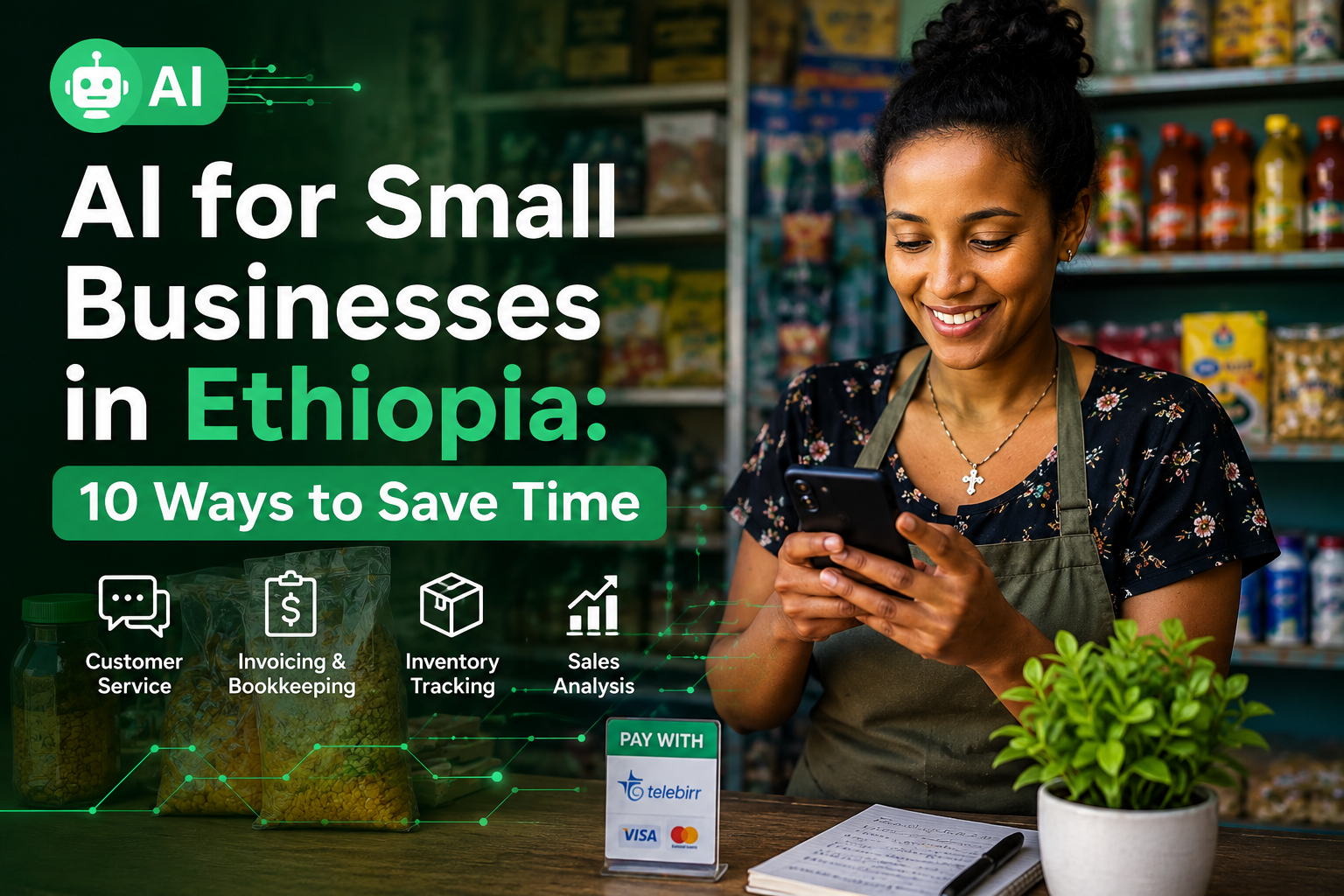
If you run a shop, salon, pharmacy, or small trading business in Addis Ababa, Hawassa, or Bahir Dar, you’ve probably heard someone tell you that AI will “transform your business.” What you actually need is simpler: fewer hours spent answering the same WhatsApp questions, a clearer picture of what’s selling, and one less thing to worry about at closing time. That’s what AI for small businesses in Ethiopia can realistically deliver right now — not a fully automated company, but a handful of free or cheap tools that quietly remove repetitive work.
This guide skips the hype. It walks through ten practical use cases you can start this month, what each tool actually costs, and where these tools break down when your customers don’t have reliable data or don’t type in English. It also explains how to measure whether a tool is genuinely saving you money before you commit to paying for it.
Why This Matters for Ethiopian Businesses Right Now
Ethiopia’s small business sector is large and growing. The Ministry of Labor and Skills’ 2025 labor-market report recorded 442,053 micro-enterprises operating in 2024, making up close to three-quarters of registered establishments, alongside nearly 107,000 small enterprises. Yet most of these businesses are working with very little slack. New 2025 Enterprise Survey data found that 75.9% of small formal Ethiopian firms are credit constrained — meaning free digital tools aren’t a nice-to-have, they’re often the only realistic option.
Technology adoption is still catching up. In the World Bank’s Firm-Level Adoption of Technology survey, only 4.3% of surveyed formal firms used cloud computing, and the same sample reported essentially no use of AI or big-data tools. Among small firms specifically, only about 35% even owned a computer. This isn’t a reason to avoid AI — it’s a reason to start with mobile-first, low-data tools rather than complex cloud software that assumes constant broadband and a laptop on every desk.
The Connectivity Reality: Plan Around Your Customers’ Data, Not Just Yours
Between 2020 and 2024, Ethiopia added roughly 7 million mobile subscribers and 4 million new internet users, pushing mobile penetration to about 33% and internet penetration to about 19% of the population. That’s real progress, but it also means a large share of your customers are still offline or on limited data bundles.
The practical takeaway: build your AI-assisted workflow around WhatsApp, Telegram, and lightweight spreadsheets before you consider anything that requires customers to visit a website or download an app. Keep a manual, phone-based fallback for customers without data — automation should reduce your workload, not exclude paying customers.
10 AI for Small Businesses in Ethiopia Use Cases
The table below summarizes each use case. Details and caveats follow.
| # | Use Case | Free Tool Option | Works Well on Mobile? |
|---|---|---|---|
| 1 | Customer service auto-replies | WhatsApp Business app, Telegram bots | Yes, but live automation needs the paid Business Platform |
| 2 | Invoicing and bookkeeping | Zoho Books (free micro-business plan) | Partially — needs data access |
| 3 | Social media content and scheduling | Buffer (free plan, 3 channels) | Yes for drafting; uploads use more data |
| 4 | Inventory and stock tracking | Google Sheets / Excel | Yes for entry; AI analysis needs internet |
| 5 | Marketing copy and ads | ChatGPT, Gemini, Claude (free tiers) | Yes, text is low-bandwidth |
| 6 | Translation for customer reach | Google Translate, Microsoft Translator | Mostly, but Afaan Oromo isn’t available offline |
| 7 | Appointment scheduling | Calendly (free plan) | Yes, but customer needs internet to book |
| 8 | Basic sales analysis | Excel/Sheets + AI assistant | Yes, files are small |
| 9 | Hiring and HR paperwork | AI assistant + Google Forms | Yes, mostly text |
| 10 | Customer feedback analysis | Sheets + AI assistant | Yes, low data use |
1. Customer Service and Auto-Replies
Put your opening hours, prices, delivery areas, and common questions into WhatsApp Business’s free greeting and away messages and saved replies. Use an AI assistant to draft polished answers, but always route complaints and payment disputes to a real person. Telegram’s bot platform is free for developers and can handle similar tasks. Keep in mind that WhatsApp’s basic free app is rule-based, not a true conversational AI — full automation generally requires the paid WhatsApp Business Platform or a third-party service.
2. Invoicing and Bookkeeping
Photograph receipts, log daily sales in a spreadsheet, and let AI flag missing entries or summarize weekly cash flow. Zoho Books offers a genuinely free plan for solopreneurs and micro-businesses, including its built-in Zia assistant. Never let AI make final tax or payroll decisions without a human check — and note that neither Zoho nor QuickBooks is pre-configured for Ethiopian tax reporting or birr-specific accounting rules.
3. Social Media Content and Scheduling
Ask an AI tool for a week’s worth of posts in English, Amharic, or Afaan Oromo, then adapt them for Facebook, Instagram, or Telegram around market days and paydays. Buffer’s free plan covers three channels and ten scheduled posts per channel. Have a fluent speaker proofread Amharic and especially Afaan Oromo copy before it goes live — machine-generated text in these languages still varies in quality by topic.
4. Inventory and Stock Tracking
A simple sheet tracking opening stock, purchases, sales, damages, and closing stock lets an AI assistant flag fast-moving items and likely stock-outs. This isn’t theoretical: a documented small-retail case study reported that automating inventory monitoring alone removed about ten hours of manual checking per month. Spreadsheet entry works fine on a phone; the AI analysis step needs a connection.
5. Marketing Copy and Advertisements
Generate a few versions of a product description, a short radio-style script, and a call-to-action, and explicitly instruct the tool to avoid unsupported claims and to use your real prices and delivery details. ChatGPT, Gemini, and Claude all offer free tiers, though usage limits shift over time — check current terms, especially around data privacy and content ownership for commercial use.
6. Translation for Customer Reach
Translate labels, menus, and short adverts between English, Amharic, and Afaan Oromo, and keep a short approved glossary for terms like delivery, refund, and expiry date so translations stay consistent. Google Translate handles Afaan Oromo online, and Microsoft Translator supports Amharic text and text-to-speech — but Google’s own support information confirms Afaan Oromo is not available as an offline language pack in the mobile app, so don’t rely on it where connectivity is weak.
7. Scheduling and Appointment Booking
Salons, clinics, tutors, and repair shops can use one free Calendly link for bookings, with automated confirmations. Calendly’s free plan supports one event type, unlimited meetings, and one connected calendar. For customers without reliable data, keep a phone-booking option — a booking link that requires internet access will quietly exclude part of your customer base.
8. Basic Sales Analysis
Export your daily sales and ask an AI assistant to calculate weekly totals, identify your top five products, and compare weekday versus weekend performance. Strip customer names and payment details before uploading anything. Treat the output as a starting point for your own judgment, not as financial advice.
9. Hiring and HR
Draft a clear job advertisement, a set of interview questions, and a short skills test with an AI assistant, then organize applications in a spreadsheet. Use fixed, job-related criteria throughout, and make sure a person — not the AI — makes the final hiring call. Translate ads into Amharic or Afaan Oromo, but have a local speaker check terminology around qualifications and employment conditions.
10. Customer Feedback and Review Analysis
Copy customer comments into a spreadsheet, classify them as price, quality, delivery, or service issues, and ask AI to identify your three most common complaints. Respond to individual customers yourself — AI is useful for spotting patterns across many comments, not for handling one customer’s specific problem.
Building a Low-Cost AI Stack for Small Businesses in Ethiopia
If you’re starting from zero, don’t try all ten at once. A realistic first stack looks like this:
- WhatsApp Business for greetings, away messages, and saved replies.
- Google Sheets or Excel for stock and sales records — add AI analysis only once your data entry is consistent.
- Google Translate or Microsoft Translator for first-draft translation, always followed by human review for anything customer-facing or legally sensitive.
- Buffer if you’re managing more than one social channel.
- Zoho Books, once your business is formal enough to need real invoicing.
What Realistic Time and Money Savings Look Like
Be skeptical of big promised numbers. A 2024 U.S. survey found more than half of small-business AI users expected to save up to 20 hours and $500–$2,000 a month — but those are self-reported expectations from vendor-sponsored research, not audited results. A documented small-retail case study reported more than 50 hours saved monthly after automating customer questions, order updates, and inventory checks, split roughly across those three tasks.
There is currently no reliable, nationally representative figure for how much Ethiopian small businesses specifically save with AI — treat any single “35% of Ethiopian SMEs use AI” style statistic with caution, since credible national survey data doesn’t currently support it. The safest planning assumption is that a business may recover several hours per week from repetitive work, not a guaranteed dollar figure.
How to Actually Measure It
Before subscribing to anything paid, track one task — say, answering delivery questions — for one week without AI, then for four weeks with it. Compare response time, missed inquiries, and hours spent. Only pay for a tool once the measured benefit clearly outweighs the monthly cost.
A Note on Limitations
AI tools can draft, summarize, and classify, but they shouldn’t make final decisions on pricing, refunds, hiring, or financial reporting — a person should always review that output. Amharic support is reasonably solid across major translation tools; Afaan Oromo works well online but has real gaps offline and in specialized business software, which mostly still assumes an English interface. Build in human review wherever the cost of a mistake is high.
3. FAQ
Frequently Asked Questions
Is AI expensive for a small shop owner in Ethiopia?
Not necessarily. WhatsApp Business, Telegram’s bot platform, Buffer’s basic plan, Google Translate, and spreadsheet-based workflows all have genuine free tiers, and Zoho Books offers a free plan for micro-businesses. The real costs tend to be data, smartphones, staff training, and any paid upgrades you choose later.
Do I need internet all the time to use these tools?
For cloud AI, live chatbots, online translation, and booking links, yes. Some spreadsheet apps allow limited offline editing, but AI analysis generally requires a connection. Keep printed price lists and phone-based alternatives for customers without reliable data.
Can AI tools work in Amharic or Afaan Oromo?
Unevenly. Amharic has solid text support in Google and Microsoft’s translation tools. Afaan Oromo works online in Google Translate but isn’t available offline in the app. Human review remains essential for advertising, contracts, and culturally specific language in both languages.
What’s the easiest AI tool to start with?
WhatsApp Business paired with a simple sales-and-stock spreadsheet. Add a free general AI assistant for drafting replies and summaries only after you’ve written down your business’s common questions and product details.
Can AI run my business without anyone checking it?
No. AI can draft, classify, and summarize, but a person should still approve prices, refunds, invoices, hiring decisions, and translations. Ethiopian technology adoption research points to skills gaps and uncertainty as real barriers — supervised, small pilots are safer than full automation.
Is AI useful even if my customers don’t use apps or websites?
Yes. You can use AI internally to draft WhatsApp replies, translate messages, and summarize sales without your customers ever interacting with a chatbot directly.
How do I know if an AI tool is actually saving me money?
Track time spent on one task for a week before adding AI, then track the same task for four weeks after. Compare response time, missed inquiries, stock-outs, and hours saved, and only keep paying for a tool once the measured benefit clearly beats the monthly cost.
Are the free plans on tools like Buffer or Calendly enough for a small business?
Often yes for a single-person or small-team operation — Buffer’s free plan covers three channels and ten posts each, and Calendly’s free plan supports one event type with unlimited meetings. Growing businesses with multiple staff or channels will likely need a paid tier eventually.