
Meta Description
Discover how multimodal AI is transforming content creation, software development, education, and digital marketing. Learn how Google’s Gemini, alongside GPT-5, Claude, and other AI models, enables creators to work faster with text, images, audio, and video in one intelligent workflow.
Why Multimodal AI Is the Next Frontier for Digital Creators
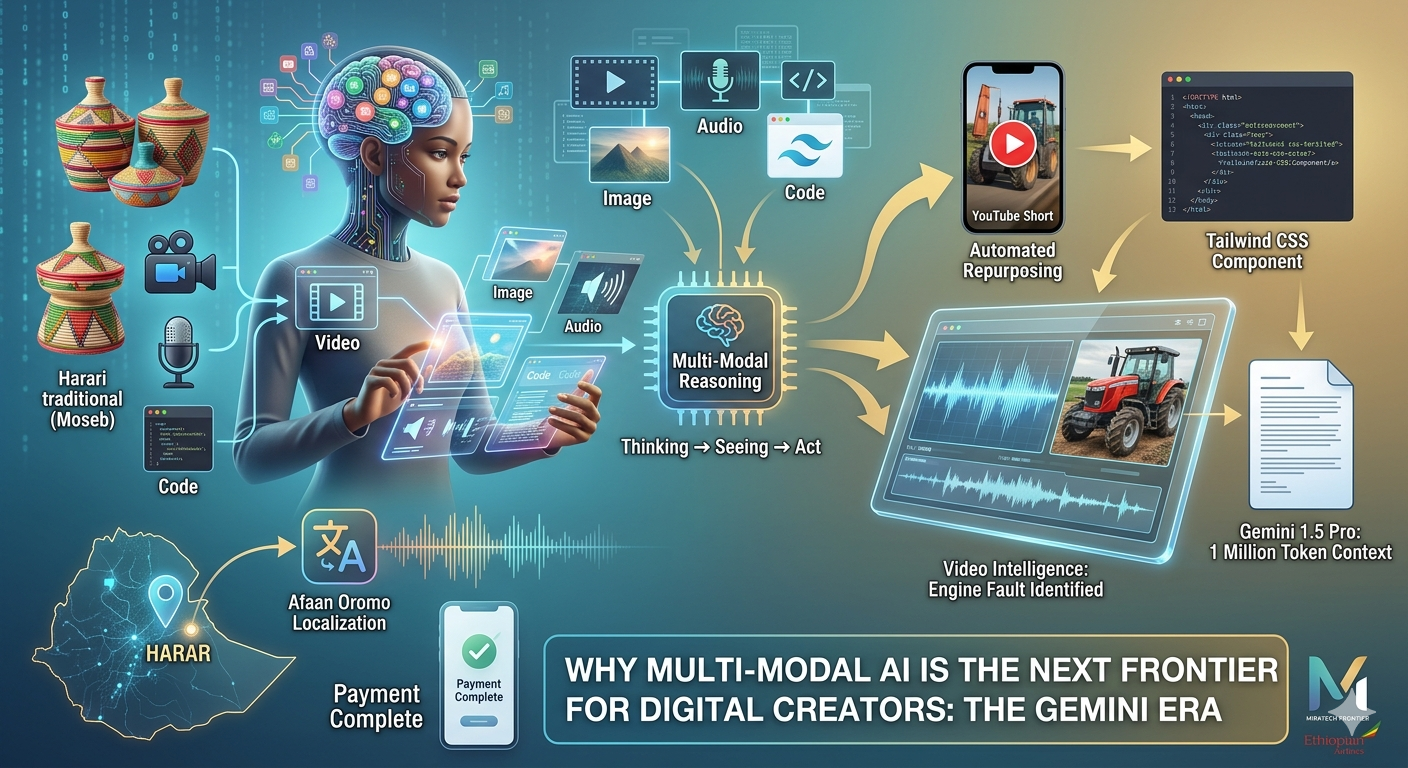
Artificial Intelligence has evolved far beyond simple text chatbots. Today’s leading AI systems can understand text, images, audio, video, documents, and even code simultaneously. This capability—known as multimodal AI—is changing how creators produce content, how businesses build products, and how developers write software.
Instead of asking an AI to analyze only written text, creators can now upload an entire YouTube video, a podcast recording, screenshots, PDFs, spreadsheets, or design mockups and receive intelligent insights in a single conversation.
Among the companies leading this transformation is Google’s Gemini family of AI models, designed from the beginning to work across multiple types of information.
For digital creators, marketers, educators, and software developers, multimodal AI represents one of the most significant productivity breakthroughs of this decade.
What Is Multimodal AI?
Traditional AI models process only one type of data—usually text.
Multimodal AI combines multiple information sources simultaneously.
For example, a single AI model can understand:
- Text
- Images
- Audio
- Video
- PDF documents
- Computer code
- Charts
- Tables
- Screen recordings
Rather than treating each format separately, the model reasons across them.
Imagine uploading:
- a product demo video,
- the product documentation,
- customer reviews,
- sales reports,
and asking:
“Why are customers abandoning this feature, and how should we redesign it?”
A multimodal AI system can analyze all those inputs together before generating recommendations.
Why Multimodal AI Matters
Modern content creation no longer happens in text alone.
Creators manage:
- YouTube videos
- Podcasts
- Instagram Reels
- TikTok clips
- Blog posts
- Newsletters
- Websites
- Online courses
Every project generates dozens of files across different formats.
Previously, each required separate software:
- Photoshop
- Premiere Pro
- Audition
- Google Docs
- Excel
- Visual Studio Code
Today’s AI models can connect information across many of these formats, reducing manual work and accelerating creative workflows.
How Google’s Gemini Approaches Multimodal AI
Google designed Gemini with multimodal capabilities as a core feature rather than adding them later.
Instead of converting everything into text first, Gemini can analyze multiple data types together.
Examples include:
- reading technical PDFs,
- understanding screenshots,
- summarizing meeting recordings,
- analyzing videos,
- explaining diagrams,
- reviewing software code.
One notable capability introduced in the Gemini 1.5 generation was a substantially expanded context window, allowing the model to process much larger collections of information than earlier systems. This makes it practical to analyze lengthy documents or large codebases in a single session, although effective limits depend on the model version and platform being used.
Real-World Applications
1. Intelligent Video Repurposing
Long-form educational videos often contain dozens of moments suitable for short-form content.
Instead of manually watching a one-hour recording, creators can ask AI to:
- identify the strongest hooks,
- suggest timestamps,
- generate subtitles,
- write YouTube Shorts captions,
- create Instagram descriptions,
- recommend titles.
This dramatically reduces editing time while helping creators publish consistently across platforms.
2. UI Design to Production Code
Developers frequently sketch interfaces on paper or whiteboards.
A multimodal AI system can analyze:
- handwritten wireframes,
- screenshots,
- Figma exports,
- user interface mockups,
and generate starter code in frameworks such as React, Next.js, or Tailwind CSS. Human review is still essential, but this can accelerate prototyping.
3. Multilingual Content Localization
Global creators increasingly publish content in multiple languages.
Instead of translating only text, multimodal AI can assist with:
- subtitle generation,
- transcript cleanup,
- translation,
- dubbing workflows,
- terminology consistency.
For creators producing Afaan Oromo educational content, AI can speed up subtitle preparation while preserving technical concepts that require careful human review for cultural and linguistic accuracy.
4. Software Development
Developers can upload:
- architecture diagrams,
- API documentation,
- source code,
- error logs,
- screenshots,
and ask AI to diagnose issues across all of them simultaneously.
This provides richer context than sharing isolated snippets.
5. Business Intelligence
Organizations increasingly combine:
- spreadsheets,
- dashboards,
- meeting notes,
- reports,
- emails,
to identify trends and support decision-making.
Rather than analyzing each file separately, multimodal AI can connect insights across them.
Benefits for Digital Creators
Multimodal AI offers several practical advantages:
- Faster content production
- Reduced editing time
- Better research workflows
- Improved accessibility through captions and transcripts
- Easier multilingual publishing
- More efficient collaboration
- Faster prototyping
- Enhanced knowledge management
These benefits are most valuable when AI complements—not replaces—human expertise.
Current Limitations
Despite rapid progress, multimodal AI is not perfect.
Creators should be aware of several challenges:
- AI can misinterpret complex visual scenes.
- Generated code often requires debugging.
- Large media files may exceed platform-specific limits.
- Cultural context and humor are not always captured accurately.
- Human verification remains essential for factual, legal, or medical content.
Responsible use includes reviewing outputs before publication.
Gemini Compared with Other Leading AI Models
| Feature | Gemini | GPT-5 | Claude |
|---|---|---|---|
| Text understanding | Excellent | Excellent | Excellent |
| Image analysis | Excellent | Excellent | Strong |
| Audio support | Strong | Strong | Limited by platform |
| Video understanding | Strong | Strong | Varies |
| Large document analysis | Excellent | Excellent | Excellent |
| Coding assistance | Excellent | Excellent | Excellent |
| Long-context workflows | Excellent | Excellent | Excellent |
The best choice depends on your workflow, budget, integrations, and preferred ecosystem rather than a single model outperforming all others in every task.
The Future of Multimodal AI
The next generation of AI is expected to move beyond understanding information toward acting on it.
Emerging trends include:
- AI agents that complete multi-step tasks
- Real-time video reasoning
- Voice-first productivity
- Robotics integrated with multimodal perception
- Personalized AI assistants that learn user workflows (with appropriate privacy controls)
- Smarter enterprise knowledge systems
These developments could reshape education, software engineering, healthcare, manufacturing, and digital media.
Practical Tips for Creators
If you’re beginning with multimodal AI:
- Organize your media library with consistent file names.
- Save original video and audio assets.
- Keep transcripts alongside recordings.
- Use screenshots when asking design questions.
- Break large projects into logical sections when needed.
- Review AI-generated outputs for accuracy and quality before publishing.
Final Thoughts
Multimodal AI represents a major shift in how we interact with technology. Rather than treating text, images, audio, and video as separate workflows, modern AI systems can reason across multiple forms of information within a single conversation.
For digital creators, educators, developers, and businesses, this opens new opportunities to streamline production, improve collaboration, and accelerate innovation. Success, however, will depend not only on adopting these tools but also on using them thoughtfully, verifying their outputs, and combining AI assistance with human creativity and judgment.
The future of content creation is increasingly multimodal—and those who learn to integrate these capabilities into their workflows will be well positioned to adapt as AI continues to evolve.
Frequently Asked Questions
What is multimodal AI?
Multimodal AI is artificial intelligence that can understand and reason across multiple types of data, such as text, images, audio, video, documents, and code.
Is Gemini the only multimodal AI model?
No. Several leading AI systems, including Google’s Gemini, OpenAI’s GPT-5, Anthropic’s Claude, and others, offer multimodal capabilities with different strengths and integrations.
Can multimodal AI replace video editors or software developers?
Not entirely. It can automate repetitive tasks, accelerate workflows, and generate drafts, but human expertise is still needed for quality control, creative decisions, and complex problem-solving.
How can creators benefit from multimodal AI?
Creators can use it to summarize videos, generate captions, assist with translations, analyze designs, produce code, organize research, and streamline content repurposing across multiple platforms.
SEO Keywords: Multimodal AI, Google Gemini, AI for Content Creators, Gemini AI, AI Video Analysis, Digital Content Creation, AI Automation, Generative AI, AI for Developers, Future of AI, AI Productivity, AI Workflows.