
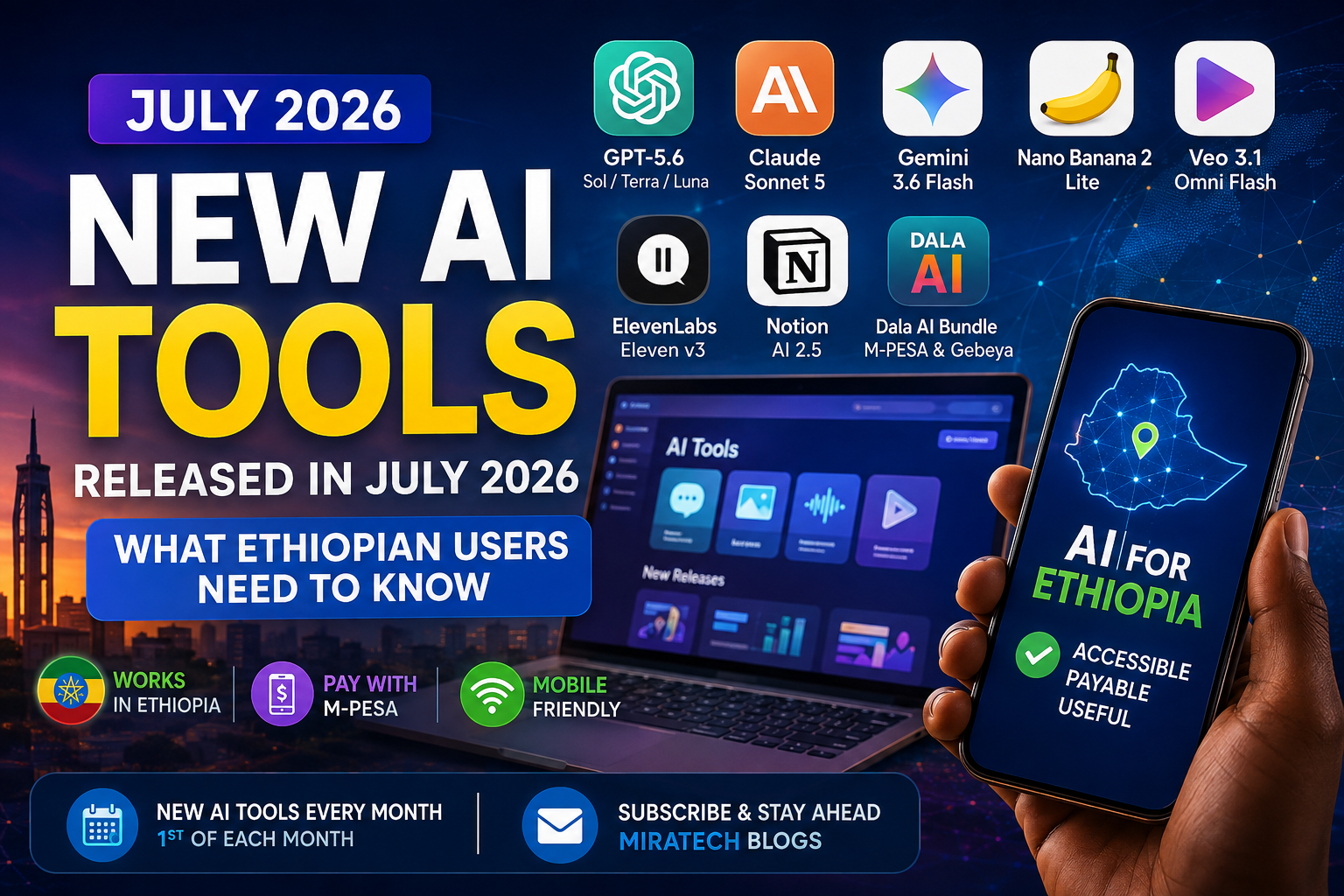
This is the first edition of MiraTech’s monthly series, “New AI Tools [Month] 2026.” We publish a fresh roundup on the 1st of every month — bookmark this page or subscribe below so you never miss one.
July 2026 was one of the busiest months the AI industry has had all year. Three major labs shipped new models on the same day, Google pushed new image and video tools into its enterprise platform, and — closer to home — a new mobile-money-powered AI bundle launched specifically for Ethiopian creators and entrepreneurs.
For Ethiopian tech enthusiasts, students, and small business owners, this pace of change is both an opportunity and a headache. New tools mean new ways to write a business plan, generate a logo, translate a document into Amharic, or automate customer replies. But it also means wasted data bundles downloading apps that don’t work here, and subscription pages that reject Ethiopian cards. That’s exactly the gap this monthly series is built to close: we test what’s new, tell you honestly what works from Addis Ababa, Bahir Dar, or Hawassa, and skip the hype that doesn’t apply to us.
Below is our full breakdown of July’s most important AI tool releases, what they cost, whether you can actually pay for them from Ethiopia, and how much mobile data you should budget for each one.
Quick Summary Table
| Tool | Category | Free Tier | Ethiopia Access | Meyra Rating |
|---|---|---|---|---|
| GPT-5.6 (Sol/Terra/Luna) | Chatbot / Reasoning | ✅ Limited | 🟢 Yes | 9/10 |
| Claude Sonnet 5 | Chatbot / Agentic AI | ✅ Limited | 🟢 Yes | 9/10 |
| Claude Fable 5 & Mythos 5 | Advanced reasoning | ❌ No | 🟡 Restricted | 6/10 |
| Gemini 3.6 Flash | Chatbot / Assistant | ✅ Yes | 🟢 Yes | 8/10 |
| Nano Banana 2 Lite | AI Image Generation | ✅ Yes (in Gemini app) | 🟢 Yes | 8/10 |
| Veo 3.1 / Gemini Omni Flash | AI Video Generation | ⚠️ Very limited | 🟡 Needs Payoneer | 7/10 |
| ElevenLabs (Eleven v3) | AI Voice & Audio | ✅ Yes | 🟡 Needs Payoneer for Pro | 8/10 |
| Notion AI 2.5 | Productivity | ✅ Limited | 🟢 Yes | 8/10 |
| Dala AI Bundle (M-PESA & Gebeya) | Africa-specific / Local languages | ⚠️ Trial only | 🟢 Yes, via M-PESA | 9/10 |
This Month’s Most Important AI Tool Releases
1. GPT-5.6 (Sol, Terra, Luna) — OpenAI
What it does: OpenAI’s newest model generation launched publicly on July 9, 2026, not as one model but three tiers. Sol is the flagship for hard reasoning, coding, and long research tasks. Terra is a balanced everyday model at roughly half the price. Luna is the fastest and cheapest, aimed at high-volume simple tasks like summarizing and drafting. All three now power ChatGPT depending on which reasoning mode you pick.
Who it’s for: Everyone from casual chat users to developers who want to route cheap tasks to a cheap model and save the expensive one for hard problems.
Free tier available? ✅ Yes — the free ChatGPT tier gives limited access to the new reasoning modes, with the paid $8/month ChatGPT Go and $20/month Plus tiers unlocking more usage.
Accessible from Ethiopia? 🟢 Yes. ChatGPT’s website and mobile app both work from Ethiopia on the free tier without any card. Upgrading to Plus requires an international card — see the barriers section below.
Mobile accessibility: Works well on the ChatGPT Android and iOS apps, including voice mode.
Data usage estimate: Roughly 1–3MB per text conversation session; voice mode can use 5–10MB per 10 minutes.
Meyra Blogs Rating: 9/10 — the biggest, most talked-about release of the month, and the free tier is genuinely usable.
2. Claude Sonnet 5 — Anthropic
What it does: Anthropic’s new default model across all Claude plans since June 30, 2026. It’s built for agentic work — coding, multi-step research, and tool use — while remaining fast and affordable enough for everyday writing, studying, and business tasks.
Who it’s for: Students who need help structuring essays, entrepreneurs drafting business plans, and developers who want an AI that can actually carry out multi-step coding tasks rather than just answer questions.
Free tier available? ✅ Yes, with daily message limits on claude.ai.
Accessible from Ethiopia? 🟢 Yes. The free tier works with just an email sign-up — no card required.
Mobile accessibility: Claude has a solid Android/iOS app; also usable through Claude in Chrome for browsing tasks.
Data usage estimate: About 1–2MB per typical chat session.
Meyra Blogs Rating: 9/10 — our top pick this month (details below).
3. Claude Fable 5 & Claude Mythos 5 — Anthropic
What it does: Anthropic’s first models above the Opus tier, released June 9, 2026. Fable 5 and Mythos 5 share the same underlying model, with Fable 5 carrying extra safety restrictions around biology, cybersecurity, and AI research topics. Notably, Anthropic briefly suspended access to both models on June 12 to comply with a U.S. Department of Commerce export control review, restoring access on July 1 once the controls were lifted.
Who it’s for: Advanced researchers and enterprise users working on frontier-level reasoning tasks. Most everyday Ethiopian users won’t need this tier — Claude Sonnet 5 covers day-to-day needs better.
Free tier available? ❌ No — this is a premium-tier model without a free option.
Accessible from Ethiopia? 🟡 Restricted. Access has fluctuated due to export-control reviews, and availability outside the API/enterprise context is limited. We recommend most readers stick with Claude Sonnet 5 for now.
Data usage estimate: Similar to Sonnet 5 per session, but usage is billed by the token via API for most access paths.
Meyra Blogs Rating: 6/10 — impressive technically, but not practical for most Ethiopian users this month given the access uncertainty.
4. Gemini 3.6 Flash & Flash-Lite — Google
What it does: Google’s newest fast-tier Gemini models, released July 21, 2026, focused on quick, everyday assistant tasks — search-style questions, quick drafts, and multimodal chat (text, image, and voice in one conversation).
Who it’s for: Anyone who wants a free, fast AI assistant baked into an app they likely already use.
Free tier available? ✅ Yes, generously, inside the Gemini app and Google Search.
Accessible from Ethiopia? 🟢 Yes. Works with any Google account, no payment needed for the core experience.
Mobile accessibility: Excellent — Gemini is built into many Android phones by default and has a lightweight app experience.
Data usage estimate: 1–2MB per text chat; image generation requests use more, roughly 2–4MB each.
Meyra Blogs Rating: 8/10 — reliable, free, and mobile-friendly, which matters a lot for Ethiopian data budgets.
5. Nano Banana 2 Lite — Google DeepMind
What it does: The newest addition to Google’s viral “Nano Banana” image generation family, released as a public-preview companion to Gemini Omni Flash on July 1, 2026. It’s built for speed — generating images in about four seconds — and is available directly inside the Gemini app.
Who it’s for: Students designing posters or presentations, entrepreneurs making quick product mockups or social media graphics, and anyone who wants to try AI image generation without a steep learning curve.
Free tier available? ✅ Yes, through the Gemini app’s built-in image generation.
Accessible from Ethiopia? 🟢 Yes, no separate payment needed for basic use inside Gemini.
Mobile accessibility: Fully usable from a phone — this is one of the most mobile-friendly image tools available this month.
Data usage estimate: Roughly 1–3MB per generated image.
Meyra Blogs Rating: 8/10 — fast, free, and genuinely useful for everyday graphics work.
6. Veo 3.1 & Gemini Omni Flash — Google
What it does: Google’s video generation tools, with Gemini Omni Flash (released July 1, 2026) adding conversational, chat-style video editing — swap a character, change a style, or relight a scene just by describing the change.
Who it’s for: Content creators, marketers, and small businesses making short promotional or social media video clips.
Free tier available? ⚠️ Very limited — most meaningful use requires a paid Google AI plan or enterprise access.
Accessible from Ethiopia? 🟡 Needs Payoneer or a virtual dollar card, since Google’s paid AI video tiers require an international payment method not commonly issued by Ethiopian banks.
Mobile accessibility: Viewing and light editing works on mobile; heavier generation is better suited to a laptop or desktop browser.
Data usage estimate: Video generation and downloads can use 20–50MB or more per clip — budget accordingly on mobile data.
Meyra Blogs Rating: 7/10 — powerful, but the payment barrier and data cost make it a “when you need it” tool rather than a daily one for most Ethiopian users.
7. ElevenLabs — Eleven v3 & Conversational AI 2.0
What it does: ElevenLabs continued expanding from text-to-speech into a full audio platform this month — natural-sounding voice generation, real-time voice changing, dubbing across 70+ languages, and voice-based AI agents for customer support or training content.
Who it’s for: Content creators making YouTube or podcast narration, students who want text read aloud for studying, and small businesses building simple voice-based customer bots.
Free tier available? ✅ Yes, with a limited monthly character allowance.
Accessible from Ethiopia? 🟡 The free tier works from Ethiopia directly. Paid tiers (needed for cloning your own voice or higher usage) typically require Payoneer or a virtual dollar card.
Mobile accessibility: Has a dedicated mobile app for quick voiceovers on the go.
Data usage estimate: Roughly 1–2MB per minute of generated audio.
Meyra Blogs Rating: 8/10 — the free tier alone is useful for students and small creators.
8. Notion AI 2.5 — Notion
What it does: A major July update that lets Notion’s built-in AI pull context from linked databases, attached files, and calendar entries — not just the page you’re currently on. This makes it far more useful for research and project tracking across an entire workspace.
Who it’s for: Students organizing coursework, and small teams or entrepreneurs managing projects, notes, and to-do lists in one place.
Free tier available? ✅ Limited AI usage on Notion’s free personal plan.
Accessible from Ethiopia? 🟢 Yes, sign-up and the free plan work without any payment.
Mobile accessibility: Strong Android/iOS app, syncs well even on slower connections.
Data usage estimate: Very light — under 1MB for most note-taking sessions; syncing attachments uses more.
Meyra Blogs Rating: 8/10 — one of the most practical productivity upgrades this month for students and small teams.
9. Dala AI Bundle — M-PESA Ethiopia & Gebeya
What it does: A genuinely Ethiopia-built launch. Gebeya’s Dala Studio now offers a bundle of localized AI tools — app building, AI agent creation, game development, comic generation, and content creation — with support for Amharic, Oromo, and other local languages. Subscriptions are payable directly through M-PESA, removing the international card requirement that blocks so many other tools.
Who it’s for: Ethiopian entrepreneurs, students, and creators who want to build apps, generate content, or automate tasks in their own language, paid for the way they already pay for everything else — mobile money.
Free tier available? ⚠️ Trial access only; full features require an M-PESA subscription.
Accessible from Ethiopia? 🟢 Yes — built for Ethiopia first, with no Payoneer or foreign card needed.
Mobile accessibility: Designed mobile-first from the ground up.
Data usage estimate: Varies by feature; text and chat-based tools stay light (1–3MB per session), while app or game generation uses more.
Meyra Blogs Rating: 9/10 — not the most powerful model on this list, but by far the easiest for an average Ethiopian user to actually pay for and use.
Our Top Pick This Month: Claude Sonnet 5
If you only try one new tool from this list, make it Claude Sonnet 5. Here’s why it beats the more famous GPT-5.6 for most Ethiopian users this month:
- It’s free to start, with no card required — just an email sign-up.
- It became Anthropic’s default model on June 30, 2026, so you’re automatically getting the newest capability without hunting through settings.
- It handles multi-step tasks well — drafting a business plan section by section, debugging code, or working through a research question — which matters more for students and entrepreneurs than raw benchmark scores.
- The mobile app is lightweight and works reliably on typical Ethiopian mobile connections.
GPT-5.6 is arguably the bigger news story of July, and it’s absolutely worth trying too — but Claude Sonnet 5’s combination of free access, everyday usefulness, and mobile friendliness makes it the safer first stop.
Tools That Don’t Work in Ethiopia Yet
In the interest of honesty, here are July’s tools that Ethiopian readers will likely hit a wall with:
- Claude Fable 5 / Mythos 5 (full access): Access has been in flux due to a U.S. export-control review that briefly suspended the models in June before being restored on July 1. Broader consumer access outside enterprise/API channels remains limited.
- Veo 3.1 paid tiers and Gemini Omni Flash full video generation: ⚠️ Needs Payoneer or a virtual dollar card, since Ethiopian bank cards generally aren’t accepted for Google’s paid AI plans.
- ChatGPT Plus, Pro, and Work tiers: ⚠️ Needs Payoneer — OpenAI does not accept most Ethiopian bank cards directly, so a virtual dollar card or Payoneer-linked card is currently the most reliable workaround.
- ElevenLabs Pro/Scale tiers (voice cloning, higher usage): ⚠️ Needs Payoneer, though the free tier works fine from Ethiopia.
If you run into a “payment declined” error on any of these, a Payoneer-issued virtual USD card or a similar prepaid dollar card service is currently the most common fix Ethiopian users report — just confirm fees before committing to a subscription.
How to Stay Updated on New AI Tool Releases
AI tools move fast enough that a single blog post can’t keep you current for long. Here’s how we recommend staying on top of it between our monthly roundups:
- Subscribe to the MiraTech newsletter (link below) — we send a short digest whenever something genuinely important launches, not every minor update.
- Join the Meyra Blogs Telegram channel for real-time alerts on tool launches, price drops, and Ethiopia-specific access news.
- Set a Google Alert for terms like “new AI tool” or the name of a platform you rely on, so you hear about major updates as they happen.
- Bookmark this series — a fresh “New AI Tools [Month] 2026” post goes live on MiraTech Blogs on the 1st of every month.
What to Expect in August 2026
A few threads worth watching as we head into next month’s edition:
- OpenAI’s promised update to its Operator web-browsing agent, which was expected in July but hadn’t shipped by the time of writing.
- Further price cuts across the GPT-5.6 family, following July 30’s cuts to Terra and Luna — expect competitors to respond.
- More movement on Africa-specific AI language models, following the G6 telecom partnership’s early Swahili reasoning model demo — an Amharic equivalent would be a big story if it lands.
- OpenAI’s Sora API is scheduled to shut down on September 24, 2026, so watch for whether a successor video tool appears before then.
We’ll cover all of it — and whatever else launches — in “New AI Tools August 2026,” live on MiraTech Blogs on August 1st.
Key Takeaways
- July 2026 brought major releases from OpenAI (GPT-5.6), Anthropic (Claude Sonnet 5, plus the Fable 5/Mythos 5 tier), and Google (Gemini 3.6 Flash, Nano Banana 2 Lite, Gemini Omni Flash).
- Claude Sonnet 5 is our top pick for Ethiopian users this month — free to start, capable, and mobile-friendly.
- A genuinely Ethiopian-built option, the Dala AI Bundle, now offers local-language AI tools payable through M-PESA — no foreign card needed.
- Several major tools, including paid ChatGPT tiers and Google’s video generation plans, still require Payoneer or a similar virtual dollar card to access from Ethiopia.
- Always check the free tier first — most of July’s biggest releases offer enough functionality to be useful without paying anything.
Frequently Asked Questions
1. What is the most important new AI tool released in July 2026? GPT-5.6 from OpenAI was the single biggest release by attention and scale, launching as three tiers (Sol, Terra, Luna) on July 9, 2026. For everyday Ethiopian users, though, Claude Sonnet 5 is the more practical first tool to try.
2. Can I use ChatGPT and Claude for free in Ethiopia? Yes. Both ChatGPT’s free tier and Claude’s free tier work from Ethiopia with just an email or Google sign-up — no card or Payoneer needed to get started.
3. Why do some AI tools ask for a card I can’t use in Ethiopia? Most premium AI subscriptions bill through international card networks that many Ethiopian banks don’t fully support for USD transactions. A Payoneer virtual card or similar prepaid USD card is the common workaround readers report.
4. Is there an AI tool built specifically for Ethiopian users? Yes — the new Dala AI Bundle from M-PESA Ethiopia and Gebeya, launched this year, supports Amharic and Oromo and is payable directly through M-PESA.
5. How often will MiraTech publish this AI tools roundup? Monthly, on the 1st of every month, as “New AI Tools [Month] 2026.” The next edition, covering August, publishes August 1, 2026.
Never Miss a Monthly AI Roundup
New AI tools launch every week, but you don’t need to track all of them — we’ll do that for you. Subscribe to the MiraTech newsletter or join our Telegram channel to get “New AI Tools August 2026” the moment it publishes, plus Ethiopia-specific access tips throughout the month.
Related reading on MiraTech Blogs:
- 10 Best AI Tools in 2026
- Best Free AI Tools for Beginners in Ethiopia
- ChatGPT vs Gemini vs Claude: Which Should You Use?
Official tool links referenced in this article: