
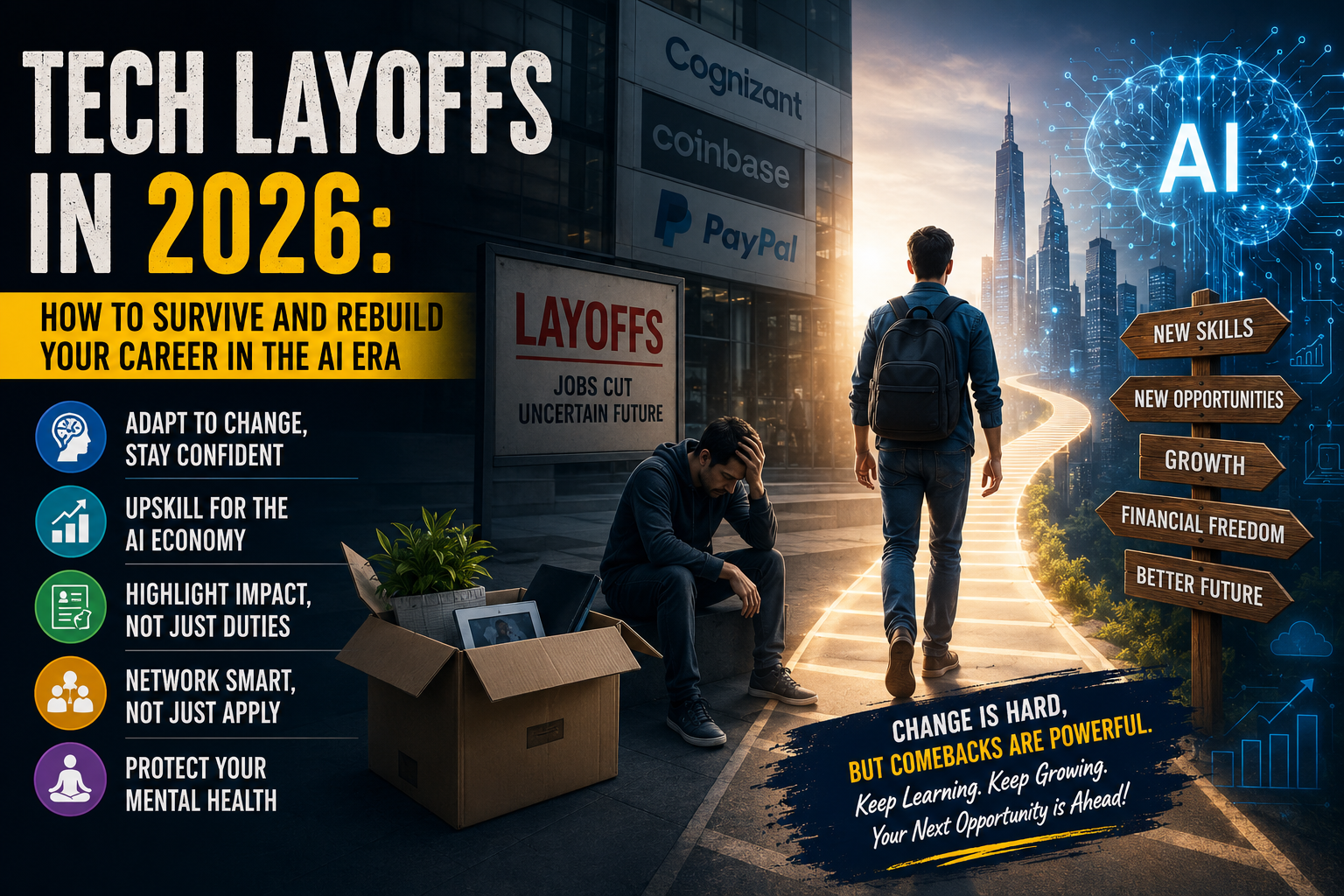
If you’re searching for ways to survive tech layoffs 2026 has become defined by, you’re not alone. Across the industry, companies are restructuring around AI, automation, and leaner teams — and the ripple effects are landing on talented people who did nothing wrong. This guide walks through five practical, actionable steps to help you steady yourself, sharpen your skills, and land your next role with confidence.
Why Tech Layoffs Are Different in 2026
This year’s wave of job cuts isn’t a typical downturn story. Companies aren’t just trimming costs — they’re rebuilding entire org charts around AI-native workflows. That means the skills that got you hired three years ago may not be the skills that get you hired next. Understanding this shift is the first step to surviving it.
The good news: demand hasn’t disappeared. It’s moved. Roles are opening up around AI tooling, data, cloud infrastructure, and product leadership. The professionals who adapt quickly are the ones who come out ahead.
1. Accept the Change Without Losing Confidence
A layoff can feel deeply personal, but in most cases it reflects budget realignment, a product pivot, or automation — not your capability.
- Give yourself permission to feel the initial shock or frustration.
- Set a short timeline (a few days, not weeks) to process, then pivot to action.
- Reframe the layoff as an inflection point, not a verdict on your worth.
Your skills and experience are still valuable. Your career is bigger than any single role.
2. Upskill with Purpose for the AI Economy
Employers who are hiring right now are prioritizing skills tied to AI, cloud, and data-driven decision-making. Rather than trying to learn everything, pick one or two areas that match your background and go deep.
High-value skills in 2026:
- Prompt engineering and AI tool orchestration
- Machine learning fundamentals and applied data analytics
- Cloud platforms and infrastructure-as-code
- Automation and AI-driven product development
- Cybersecurity for AI systems
- Product management and cross-functional leadership
- No-code/low-code platforms for rapid prototyping
Your 90-Day Learning Plan Template
- Days 1–15: Pick your focus area and complete a foundational course. Join one online community in that space.
- Days 16–45: Build a small project that applies what you’ve learned — a script, dashboard, prototype, or case study.
- Days 46–75: Publish your project (GitHub, portfolio site, or LinkedIn post) and gather feedback.
- Days 76–90: Refine the project, add it to your resume, and start mentioning it in interviews and networking conversations.
Related reading: AI skills to learn this year
3. Make Your CV Results-Oriented and ATS-Friendly
Recruiters spend seconds scanning a resume, and most companies filter applications through an Applicant Tracking System (ATS) before a human ever sees them. Two things matter most: keywords and measurable outcomes.
- Open with a concise professional summary tailored to the specific role.
- Use clear formatting and include relevant keywords — AI tools, cloud providers, frameworks.
- Quantify your impact wherever possible: revenue, time saved, efficiency gained, growth achieved.
Resume bullet examples (before → after):
- “Managed social media accounts” → “Increased social engagement 45% in six months using AI-driven content scheduling and A/B testing.”
- “Responsible for backend development” → “Reduced API response time by 30% by re-architecting backend services for a 200K-user platform.”
- “Worked on customer support tickets” → “Cut average ticket resolution time by 25% by implementing an AI-assisted triage workflow.”
Add links to code repositories, project demos, or case studies that back up your claims.
Related reading: how to build a portfolio that gets noticed
4. Prioritize Networking Over Cold Applications
Many roles are filled through referrals long before they’re posted publicly. A focused, generous approach to networking beats mass-applying to job boards.
Networking outreach template:
Hi [Name], I hope you’re doing well. I noticed [specific detail about their work/company]. I’m currently exploring opportunities in [field/role] and would love to hear about your experience at [company] — would you be open to a 15-minute chat sometime this week?
Other ways to build momentum:
- Reconnect with former managers and teammates; ask for informational chats, not favors.
- Engage in specialized communities like GitHub, Dev.to, and product forums.
- Attend virtual and local meetups, conferences, or hackathons.
- Offer value first — share insights, make introductions, or contribute to open projects.
5. Protect Your Mental Health and Structure Your Search
A job search is a marathon, not a sprint. Protecting your wellbeing directly affects how well you perform in interviews and how long you can sustain the effort.
- Keep a consistent daily routine: sleep, exercise, and time with family or friends.
- Set realistic, measurable daily goals for upskilling and outreach.
- Limit social media time and resist comparing your timeline to others.
- Lean on career coaches, mentors, or peer groups for accountability and feedback.
Related reading: managing mental health during a job search
Rebuilding a Resilient Career
The AI-driven transition is reshaping roles across tech, but it’s also creating new openings for people willing to adapt. Whether you deepen your technical expertise, move into product or leadership, or blend domain knowledge with AI fluency, the professionals who combine curiosity with a clear strategy will come out ahead.
Take action today:
- Map the one or two skills you’ll build over the next 90 days.
- Rewrite two resume bullets to lead with outcomes, not duties.
- Send three networking messages using the template above.
- Block 30 minutes tomorrow morning for focused learning.
How Young Africans — and Ethiopia’s Workforce — Can Prepare for the Coming AI Era
The shift reshaping tech jobs worldwide isn’t only a Silicon Valley story. Across Africa, and in Ethiopia specifically, a young, fast-growing workforce has a real opportunity to leapfrog into the AI economy rather than simply react to it later.
Why this moment matters for Ethiopia and the wider region:
- A large youth population means the workforce entering the job market over the next decade will be shaped from the start by AI-native tools, rather than having to unlearn older ways of working.
- Remote and hybrid work has opened global roles to talent based in Addis Ababa, Nairobi, Lagos, or Kigali — geography matters less than skills and portfolio.
- Local tech hubs, universities, and coding bootcamps are increasingly offering AI, data, and software training, closing the gap with global markets.
Practical steps for young professionals and students in Ethiopia and across Africa:
- Build digital-first skills early. Prioritize coding, data literacy, and AI-tool fluency alongside traditional degrees — free and low-cost resources (YouTube courses, Coursera, local coding academies) make this accessible even with limited budgets.
- Use English-and-local-language content strategically. Publishing project work or writing in both English and local languages (like Amharic) widens your reach — to global recruiters and to the growing local tech ecosystem.
- Tap into regional tech communities. Hubs like iCog Labs, Ice Addis, and university innovation centers in Ethiopia, along with pan-African communities, provide mentorship, hackathons, and connections that substitute for formal networks elsewhere.
- Freelance and remote-first platforms as a launchpad. Sites that connect African freelancers to global clients let young professionals build a track record and portfolio without needing to relocate first.
- Think in problems, not just tools. The most resilient careers won’t come from mastering one AI tool, but from learning to solve local problems — agriculture, fintech, healthcare access — with AI as leverage. This is where African talent has a distinct advantage: deep understanding of local context that outside teams don’t have.
The world’s AI transition isn’t only about surviving disruption — for a young, adaptable workforce in Ethiopia and across Africa, it’s also a genuine opening to build careers, companies, and solutions rooted in the problems they understand best.
Related reading: AI skills to learn this year | remote work opportunities for African tech talent | building a tech career from Addis Ababa